
Up Jumped the Devil!
Merritt Brunies and His Friars Inn Orchestra — Chicago Jazz in the Roaring Twenties
Chicago, 1924. Jazz was filling the city’s dance halls and nightclubs, and musicians from New Orleans were helping to transform American popular music. Among them was cornet player and bandleader Merritt Brunies, whose orchestra recorded a wonderfully mischievous little number entitled Up Jumped the Devil.
For today’s Halloween Needle Drop, we travel back more than a century to explore the musicians, the remarkable Brunies family, the celebrated Friars Inn and the surviving recordings of this spirited piece of early jazz.
The Brunies Brothers: A New Orleans Musical Family
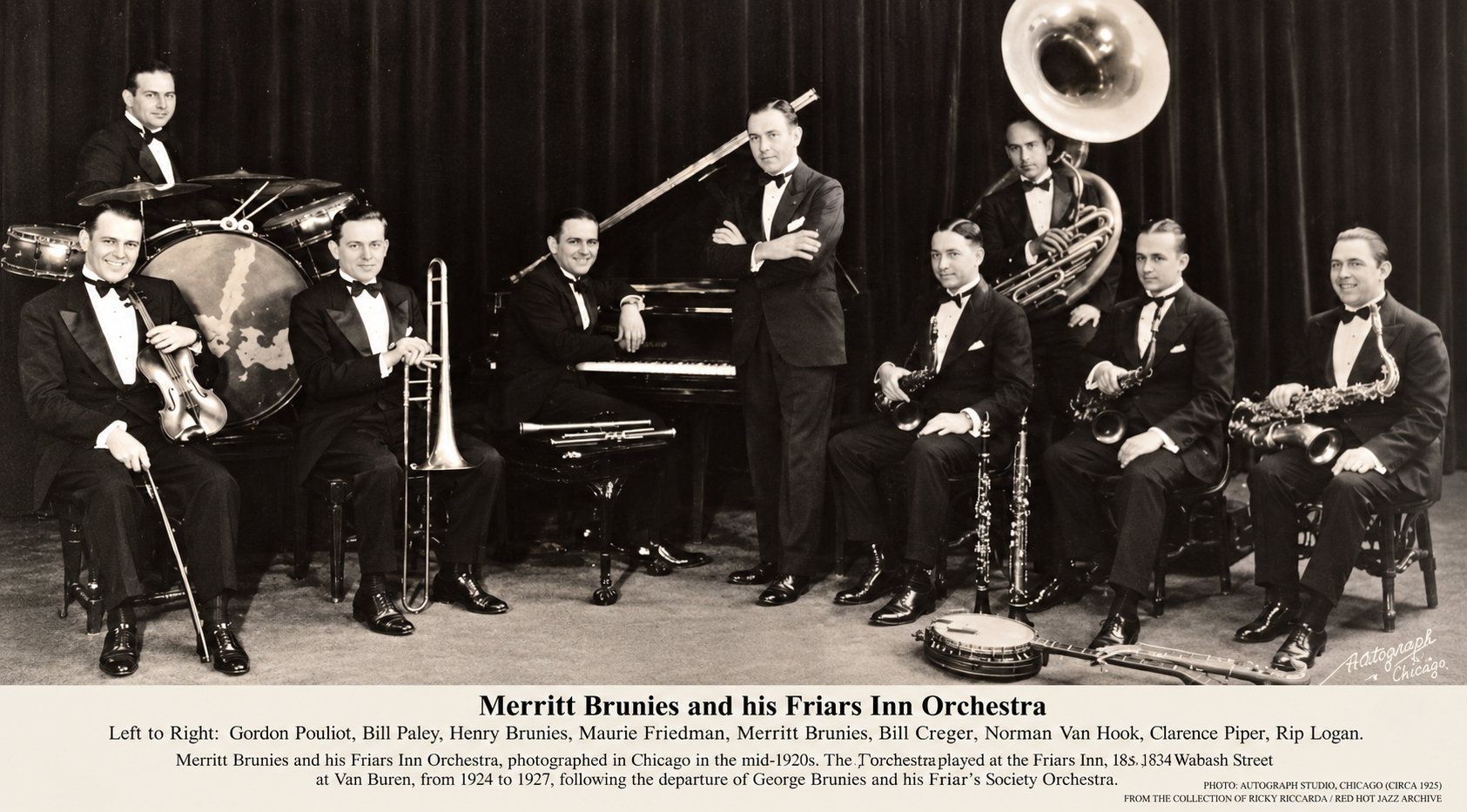
Merritt Brunies (1895–1973) belonged to one of the musical families associated with the early development of New Orleans jazz. His brothers included George Brunies, the celebrated trombonist associated with the New Orleans Rhythm Kings; Henry Brunies, who played trombone in Merritt’s orchestra; and Abbie Brunies, leader of the Halfway House Orchestra.
The brothers’ careers followed different paths, but together they illustrate the movement of jazz musicians from New Orleans into the bustling musical world of Chicago during the 1920s.
Merritt established himself as a cornet player and orchestra leader. In 1924, his band succeeded the earlier Friars Society Orchestra at the Friars Inn, where George Brunies had previously performed.
The Friars Inn: Jazz on Wabash Avenue
The Friars Inn stood at the corner of Van Buren Street and Wabash Avenue in Chicago. It was one of the establishments associated with the city’s early jazz scene, offering dining, dancing and a varied programme of live entertainment.
Its attractions were not confined to instrumental jazz. Popular singers, dancers and speciality performers shared the bill, reflecting the variety expected of a fashionable nightclub in the Roaring Twenties.
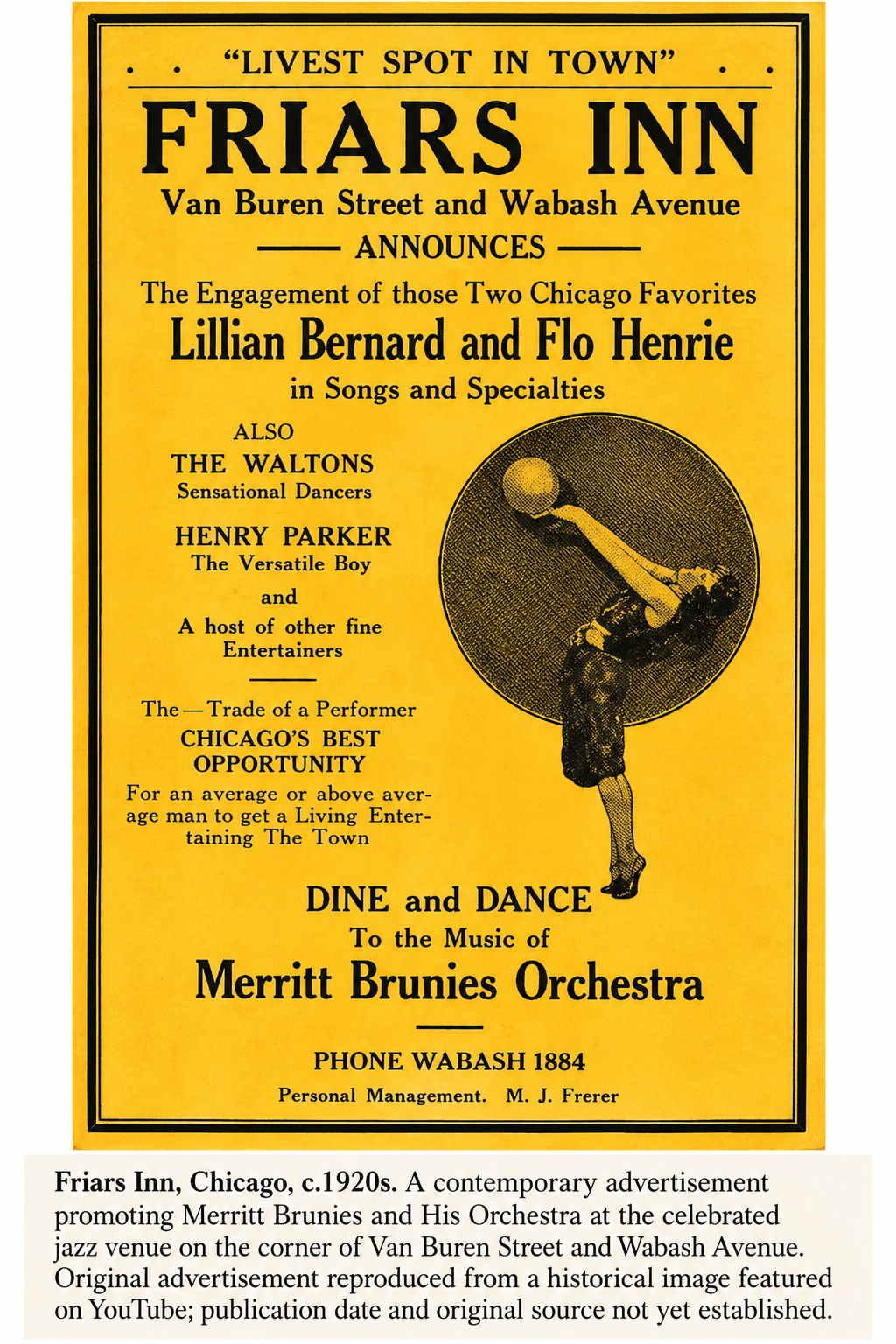
A surviving advertisement describes the Friars Inn as the “Livest Spot in Town”. Among its advertised entertainers were Lillian Bernard and Flo Henrie, while near the bottom appeared the invitation to dine and dance to the music of Merritt Brunies’s orchestra.
It is a fascinating reminder of the world in which these recordings were made: crowded dance floors, popular entertainment, late-night performances and musicians working at the heart of a rapidly developing jazz culture.
Merritt’s orchestra remained associated with the Friars Inn for approximately three years before moving to the Cinderella Ballroom.
Up Jumped the Devil — Three Recordings of One Tune
The earliest documented recording of Up Jumped the Devil by Merritt Brunies and His Friars Inn Orchestra was made in Chicago in September 1924 for the independent Autograph label, matrix 613-2.
The composition is associated with Merritt Brunies, Henry Brunies and Joe Lyons, although surviving discographical sources differ in their presentation of the credits.
The orchestra returned to the piece for Okeh on 14 November 1925, but that performance was not commercially issued at the time. A further version followed on 2 March 1926 and appeared on Okeh 40618.
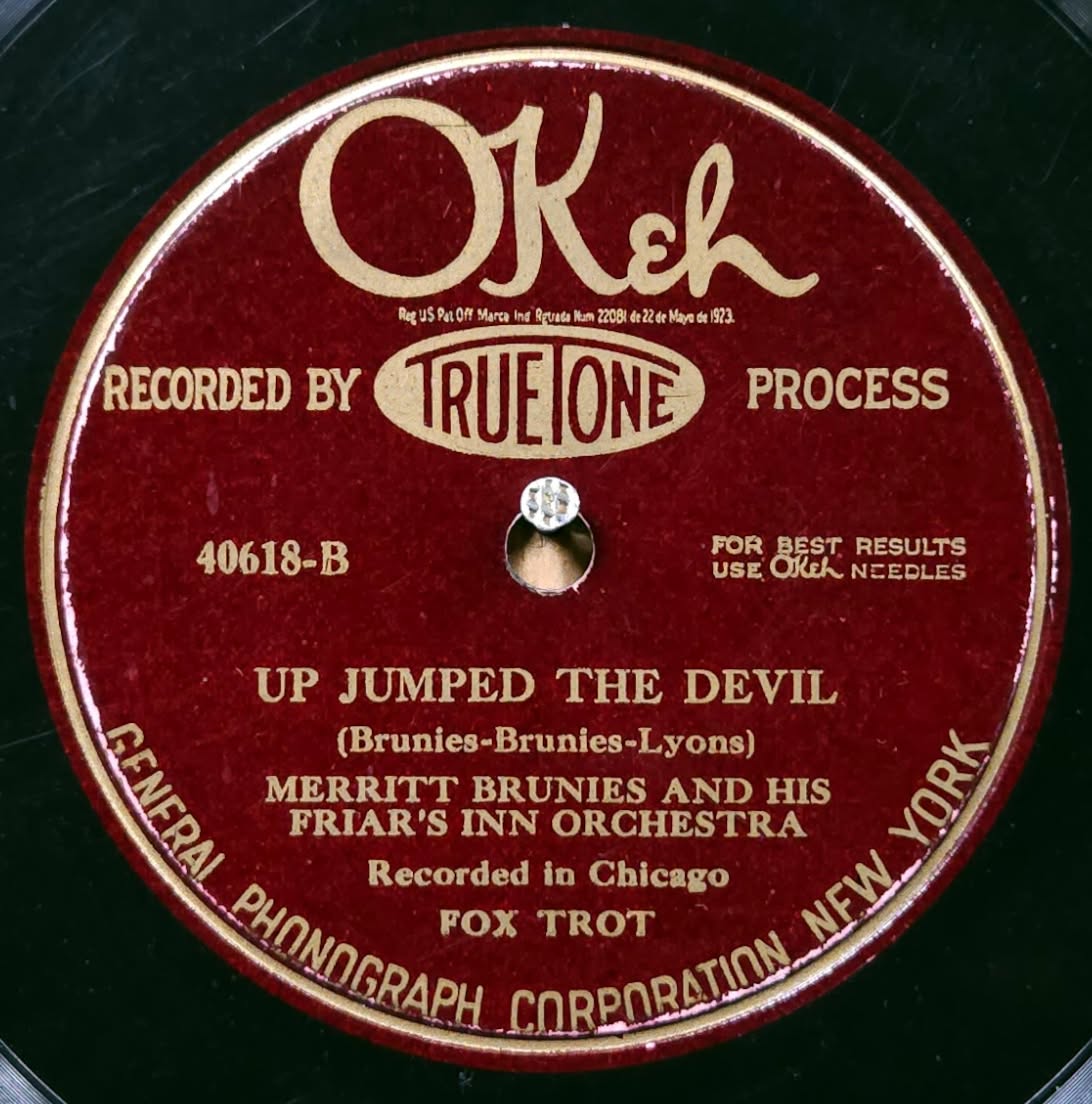
These three recordings provide an opportunity to examine how a jazz arrangement could change over time. Rather than treating the music as something permanently fixed, musicians could vary solos, ensemble passages and accompaniment between performances.
For collectors and historians, the differences between the Autograph and Okeh recordings are part of their enduring fascination.
The Original 78 rpm Discography
The following selected discography brings together original Okeh and Odeon issues listed for Merritt Brunies and His Friars Inn Orchestra, together with the earlier Autograph recording of Up Jumped the Devil.
| Year | Label / Catalogue | Recordings |
|---|---|---|
| 1924 | Autograph Matrix 613-2 |
Up Jumped the Devil |
| 1926 | Okeh 40526 | Want a Little Lovin’ / Sugar Foot Stomp |
| 1926 | Okeh 40576 | I’m as Blue as the Blue Grass of Kentucky / When Autumn Leaves Are Falling |
| 1926 | Okeh 40579 | Flamin’ Mamie / Hangin’ Around |
| 1926 | Okeh 40593 | Someone’s Stolen My Sweet, Sweet Baby / Masculine Women! Feminine Men! |
| 1926 | Okeh 40618 | Up Jumped the Devil |
| 1926 | Odeon O-3376 | Good Night I’ll See You in the Morning / Up Jumped the Devil |
Discographical note: The Odeon issue couples Tom Brown and His Merry Minstrel Orchestra with Merritt Brunies and His Friars Inn Orchestra. The November 1925 Okeh recording of Up Jumped the Devil was unissued at the time and is therefore not listed as a contemporary commercial 78 rpm release. This is a selected discography, not a complete listing of the orchestra’s recordings.
The repertoire illustrates the range of music expected from a professional dance orchestra in the mid-1920s: hot jazz, popular songs, novelty numbers and lively dance arrangements.
The Musicians Behind the Music
The personnel of Merritt Brunies’s orchestra changed over the course of its recording career. Musicians associated with the ensemble included Henry Brunies, Volly De Faut, Bill Creger, Clarence Piper, Dudley Mecum, Maurice Friedman, Norman Van Hook, Bill Paley and Rip Logan.
The cornet, trombone and reed instruments helped give the orchestra its characteristic early jazz sound, with the New Orleans ensemble tradition remaining an important influence.
The Brunies Family: A Musical Legacy
The family’s musical history extended far beyond the recordings of the 1920s.
George Brunies remained active as a jazz trombonist for decades. One intriguing recollection shared by a YouTube contributor places him performing in a small bar near Howard Street on Chicago’s North Side during the late 1960s. The establishment has not yet been identified, but the account offers a glimpse of the continuing musical life of one of early jazz’s notable trombonists.
Merritt’s son, Merritt A. Brunies (1923–2019), affectionately known as “Blue”, also inherited the family’s musical interests. Born in San Francisco, he grew up on the Mississippi Gulf Coast, organised a swing orchestra while at school and later attended Louisiana State University on a music scholarship, playing lead trumpet.

The LP Brunies Brothers Dixieland Jazz Band offers another reminder of the family’s continuing place in traditional jazz. Its sleeve lists venues associated with the musicians and recalls the world of the clubs and dance halls in which their music flourished.
The Devil in Blues and Jazz — Another Story for Another Day
There is, of course, a great deal more we could say about the devil in blues and jazz.
Across the history of both musical traditions, the devil has appeared in song titles, lyrics, folklore and popular imagination. In the blues particularly, an extraordinary amount of mythology has grown up around certain musicians and recordings, sometimes overshadowing the music and the people who actually made it.
It is a fascinating subject, and one deserving of an article in its own right.
Today, however, we are not venturing into that complicated history. We are simply borrowing the wonderfully mischievous title for our Halloween Needle Drop and taking the opportunity to celebrate Merritt Brunies and His Friars Inn Orchestra in their own right.
Listen to Up Jumped the Devil
Our featured recording can be found as Track 2 on Document Records’ Swingin’ at the Séance, Volume 1 — Jazz for a Halloween’s Night, a collection celebrating the more unusual, playful and occasionally spooky side of vintage jazz.

Find Swingin’ at the Séance, Volume 1 in the Document Records store
A Question for Our Readers
Do you collect original jazz 78s, or have you ever come across recordings by Merritt Brunies and His Friars Inn Orchestra?
Perhaps you have a photograph, an old programme, an advertisement or a memory relating to the Brunies family or Chicago’s early jazz clubs.
We would love to hear from you. At Document Records, we believe that preserving the music also means preserving the stories of the people who made it.
Research and Further Reading
The Syncopated Times — Merritt Brunies and His Friars Inn Orchestra
VJM — Brunies Family Jazz History
Discogs — Merritt Brunies and His Friars Inn Orchestra
Riemann Family Funeral Homes — Merritt A. Brunies Obituary
Additional discographical references: Brian Rust, Jazz and Ragtime Records (1897–1942); historical Autograph and Okeh recording information.
Estimated reading time: 8 minutes