
The remarkable story of the Tennessee singer and songwriter whose six surviving recordings captured faith, tragedy, death and Black life in Depression-era Knoxville.
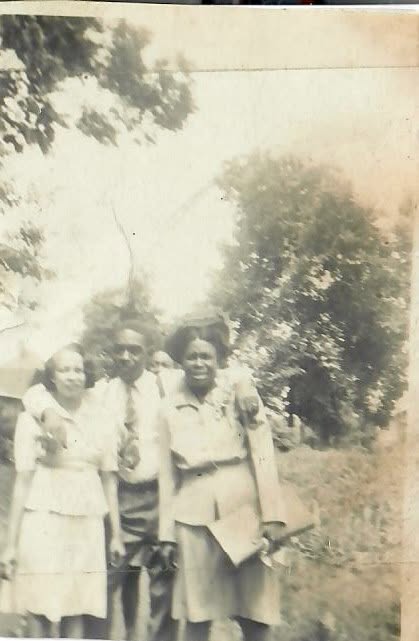
There are musicians whose importance can be measured in decades of recordings, hundreds of performances and shelves of documentation. And then there is Leola Manning.
Her known commercial recording career consists of just six sides, made during two visits to a temporary recording studio in Knoxville, Tennessee, in 1929 and 1930.
Six performances.
Yet within those six records is an extraordinary world: gospel and blues, faith and temptation, death and disaster, the streets of Knoxville, the headlines of the local newspapers and the complicated relationship between sacred and secular music in African American life.
Manning was not simply singing songs. At her most remarkable, she was documenting the world around her.
Nearly a century later, her recordings also remind us of something easily forgotten when the history of American roots music is divided neatly into genres. Black musicians were an important part of the musical culture of Appalachia, and the music captured in Knoxville in 1929 and 1930 was considerably more diverse than the familiar story of early commercial country music might suggest.
Leola Manning belongs within that larger history.
FROM CHATTANOOGA TO EAST TENNESSEE
Leola Manning was born on 10 September 1902 in Chattanooga, Tennessee. Genealogical research into her family is complicated by changes and variations in names in census records, but the available research places her childhood within a family whose movements took her from Chattanooga to La Follette, Tennessee, before she became associated particularly with Knoxville.
Research published in connection with The Knoxville Sessions, 1929–1930: Knox County Stomp identifies Manning as having grown up with the sacred music she heard from her mother and describes her as an “evangelical street singer.”
That description is important.
For Manning, gospel and blues were not necessarily two completely separate musical worlds. Her recordings demonstrate how closely those worlds could exist musically, even while the moral distinction between sacred and secular music could be profound for the people performing it.
The East Tennessee into which Manning grew was itself musically complex. Black and white musicians performed in streets, churches, dances and community gatherings, sometimes hearing and learning from one another despite the rigid racial segregation of the period.
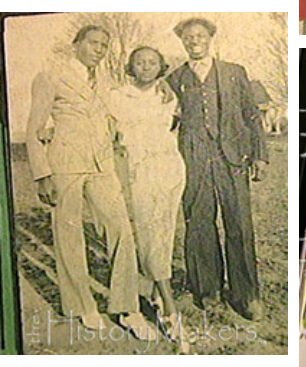
Among the African American musicians associated with this region was the remarkable fiddler Howard “Louie Bluie” Armstrong, later celebrated internationally through Terry Zwigoff’s documentary Louie Bluie. Armstrong and Manning belonged to overlapping East Tennessee musical worlds, and local recollections provide a fascinating later connection between Armstrong and Manning’s family.
By the end of the 1920s, however, something happened that would preserve Manning’s voice for generations who had not yet been born.
The recording industry came to Knoxville.
THE KNOXVILLE SESSIONS
The celebrated Bristol Sessions of 1927 have long occupied a prominent position in histories of American country music. The Knoxville sessions of 1929 and 1930 are less famous, but their breadth is remarkable.
The Brunswick-Balke-Collender Company brought recording equipment to Knoxville and established a temporary recording operation associated with the St. James Hotel.
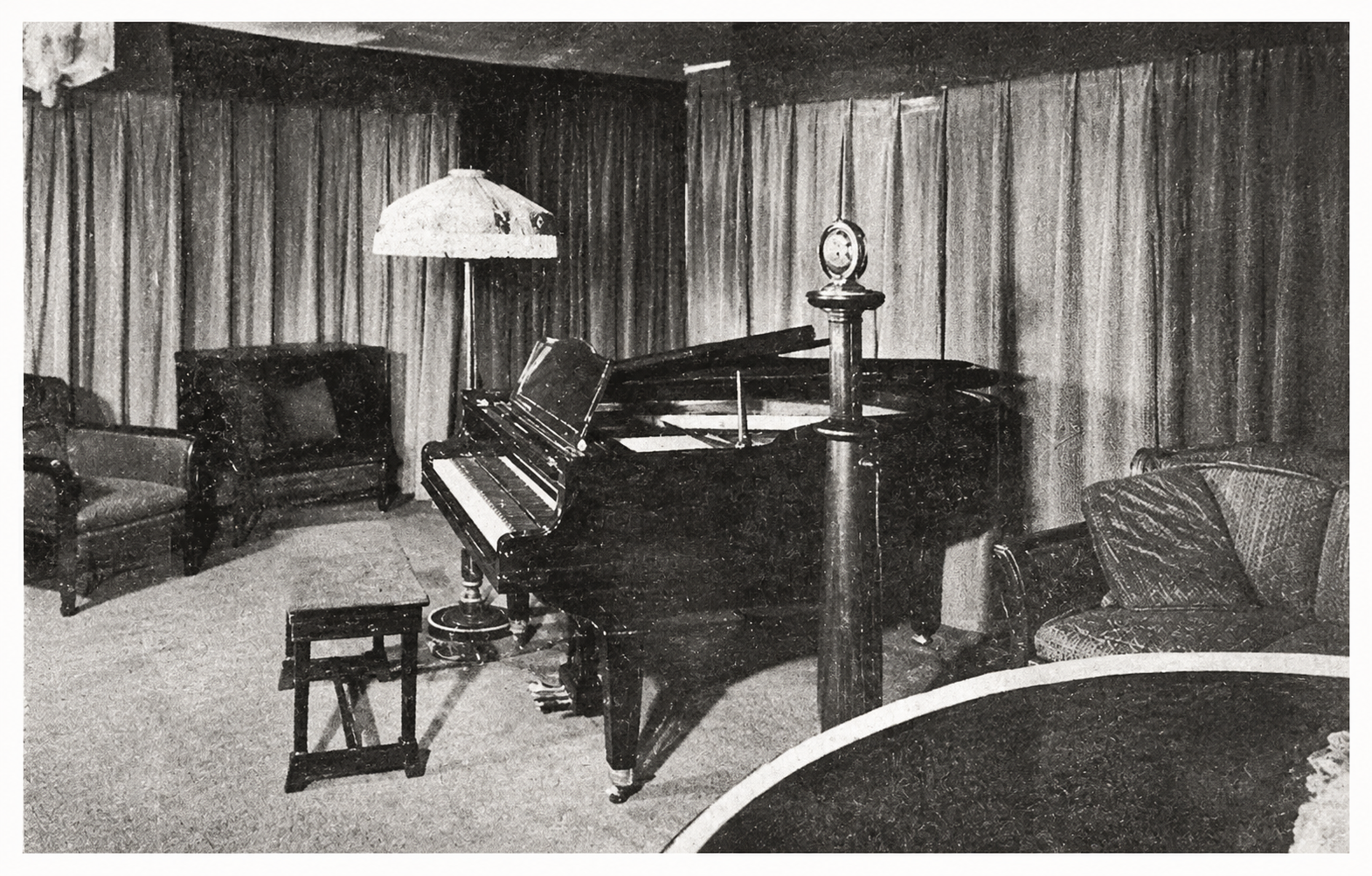
The musicians who came before the microphones represented an unusually broad cross-section of regional music.
There were old-time string bands, sacred performers, blues singers, dance musicians and songsters. Among the Black musicians recorded during the Knoxville sessions were Will Bennett, Leola Manning and the Tennessee Chocolate Drops, the latter featuring Howard Armstrong, Carl Martin and Roland Martin.
The surviving Knoxville recordings consequently challenge any simple idea that Appalachian music can be divided cleanly into “white country music” on one side and African American music somewhere else.
Leola Manning entered this world on 28 August 1929.
She recorded two religious performances: “He Cares for Me” and “He Fans Me.”
Document Records’ discographical information credits Manning with vocals and piano and Eugene Ballinger with guitar. Other later discographical research has proposed different piano personnel. Where surviving sources disagree, the precise instrumental attribution should therefore be approached with appropriate caution. What is clear is that Ballinger was closely associated with Manning’s recorded work.
What is not in doubt is the extraordinary voice at the centre of the records.
Manning sounds as though the church is never far away.
And then she came back.
APRIL 1930: FOUR EXTRAORDINARY RECORDINGS
On 4 April 1930, Manning returned to record in Knoxville.
This time she left four sides:
“The Arcade Building Moan”
“Satan Is Busy in Knoxville”
“Laying in the Graveyard”
“The Blues Is All Wrong”
Together they constitute one of the more unusual small bodies of work in pre-war blues.
These were not simply conventional blues compositions about love, abandonment or hardship. Manning drew upon the world immediately around her, combining blues and religious sensibilities with topical songwriting and moral commentary.
At least two of the records have been connected by researchers with recent tragedies in Knoxville.
THE ARCADE BUILDING MOAN
In March 1930, a disastrous fire struck Knoxville’s Arcade Building.
Within a matter of weeks Manning had transformed the catastrophe into song.
“The Arcade Building Moan” belongs to a much older tradition of disaster ballads and topical songs in which singers turned fires, murders, railway wrecks and other events into musical narratives.
But Manning’s record is striking for its immediacy.
This was not an old tragedy passed down through generations. It was recent news.
Her song therefore gives us something more than a blues performance. It gives us a glimpse of how news could travel into vernacular music almost immediately: an event occurs, a community talks about it, a songwriter absorbs it, and the event becomes a song.
SATAN IS BUSY IN KNOXVILLE
If “The Arcade Building Moan” demonstrates Manning’s response to public disaster, “Satan Is Busy in Knoxville” is perhaps still more remarkable.
For many years the precise events behind the song were uncertain. Later research by Knoxville historian Jack Neely, prompted in part by British blues interest in Manning, connected its narrative with two apparently unrelated murders in Knoxville during early 1930.
Here again Manning’s response was not simply reportage.
Her interpretation was moral and religious.
Violence in Knoxville became evidence of Satan at work.
This is one of the keys to understanding Manning. The blues vocabulary and the evangelical worldview were not mutually exclusive ingredients in these recordings. She could use musical forms associated with blues while interpreting contemporary events through the moral framework of her religious beliefs.
That makes labels such as “blues singer” and “gospel singer” useful, but insufficient.
Leola Manning was both more complicated and more interesting than either description alone suggests.
LAYING IN THE GRAVEYARD
Then comes the title which, even before the needle reaches the groove, demands attention:
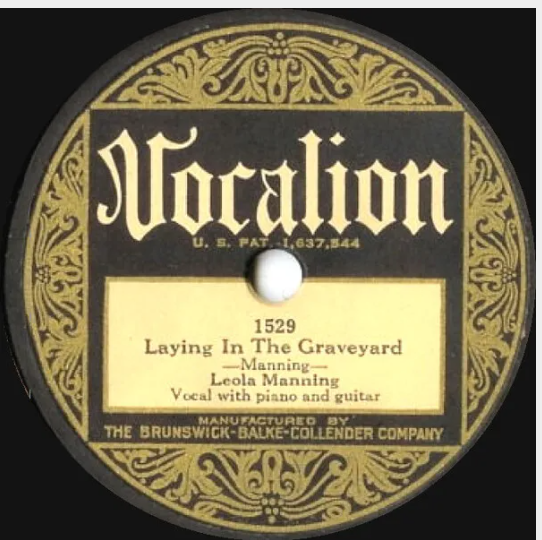
Original Vocalion 1529.
Issued with “The Blues Is All Wrong” on Vocalion 1529, the record belongs to the same remarkable April 1930 group of performances.
Today the title can easily be detached from its context and treated as simply another macabre old blues title. But placed alongside Manning’s other work, death and the graveyard belong to a much larger preoccupation with mortality, morality and salvation.
The graveyard was not merely Gothic scenery.
For a singer whose musical imagination had been formed by evangelical religion, death carried consequences. The proximity of death, judgement, sin and redemption runs through a great deal of African American sacred music, just as death, violence and burial appear repeatedly in blues and traditional song.
Manning stood at a particularly interesting meeting point between those traditions.
“Laying in the Graveyard” is therefore valuable not because its title sounds strange or sensational nearly a century later, but because it survives as part of this tiny and highly individual recorded legacy.
THE BLUES IS ALL WRONG
The title of Manning’s final known recording is almost irresistible in light of what happened afterwards.
“The Blues Is All Wrong.”
It would be tempting to treat the title as a simple declaration that Manning had rejected the blues. Her relationship with secular music, however, appears to have been more complicated than such a neat interpretation allows.
There is documentary evidence that she was still performing blues after the April recording session.
An advertisement discovered in Knoxville archives announced “Leola Manning and Her Gang” at the Columbia Radio and Electric Show’s “Negro Day” at a tobacco warehouse on McCalla Avenue in September 1930.
The advertisement specifically announced that “Leola sings blues with the orchestra.” A crowd of 3,000 was expected.
That small advertisement is an enormously valuable piece of evidence.
It demonstrates that Manning’s musical life extended beyond six sides made for Vocalion and suggests that she possessed a meaningful local reputation within Knoxville’s Black community.
It also warns us against imposing too simple a chronology upon her life.
Manning did eventually turn decisively toward religious work. But five months after her final recording session she was still being publicly promoted as a blues performer.
The movement from blues performance to church life was therefore a process, not necessarily an instantaneous conversion.
THE SINGER WHO WALKED AWAY FROM RECORDING
After 1930, the commercial recording trail ends.
No later Leola Manning recordings are presently known.
Research associated with the Knoxville Sessions describes her as devoting herself increasingly to evangelical work, continuing to write songs for religious purposes rather than commercial recording. Knoxville historical research also records that she preached and founded small churches in the area.
Later local and family accounts connect her life closely with Eugene Ballinger and identify Bishop Bobby Jean Moore as their daughter. Those recollections are important to Manning’s later story, although some details remain better documented through oral and local history than through readily accessible contemporary records.
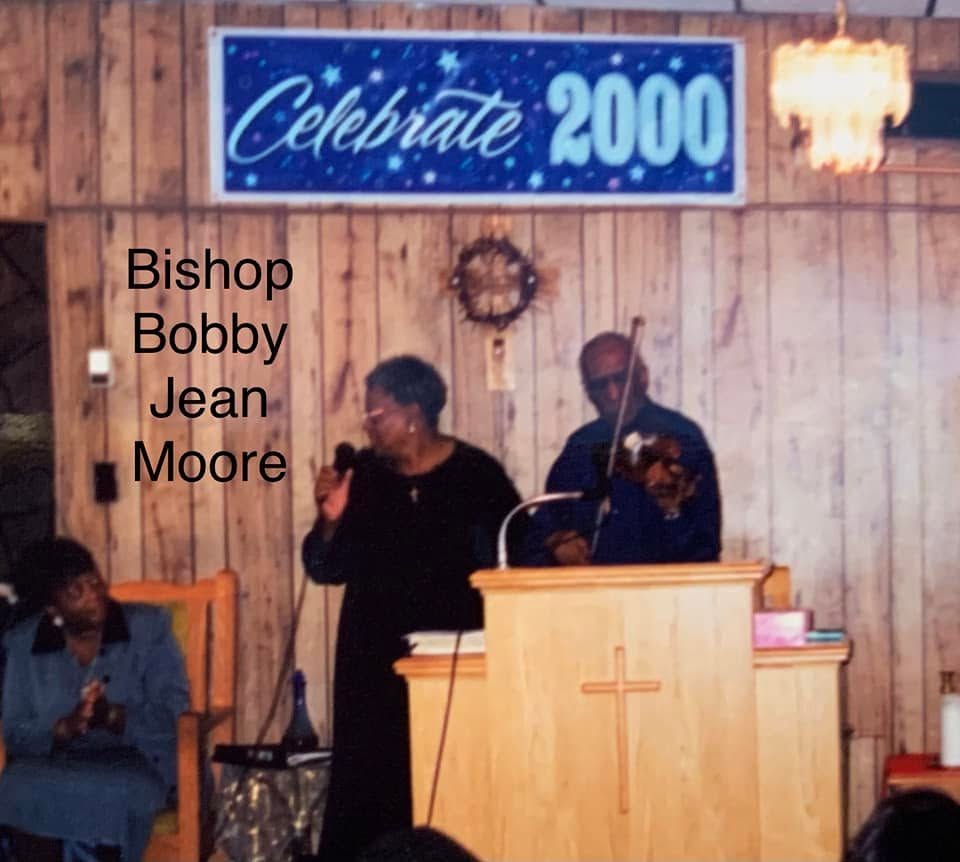
A particularly moving local recollection comes from Bill Claiborne, who remembers visiting the church in 2000 with Howard Armstrong and seeing Armstrong welcomed by Manning’s family and congregation. Manning herself had died by then, but Claiborne recalls Bishop Bobby Jean Moore leading the church and Armstrong playing his fiddle during the visit.
We preserve that account here as an attributed eyewitness recollection rather than silently turning oral history into documentary fact.
There is something extraordinary about the contrast between Manning’s brief recording career and the long life that followed it.
For collectors and historians today, those six fragile performances are the principal reason her name has travelled internationally.
For much of Manning’s own later life, the records appear to have belonged to another chapter altogether.
Leola Manning died in Knoxville on 1 February 1995, aged 92.
By then, however, the process that would eventually restore her to musical history was beginning.
REDISCOVERY
Old 78 rpm records have peculiar afterlives.
A record made for immediate commercial sale in 1929 or 1930 may disappear almost completely, surviving in only a handful of collections. Decades later a collector finds a copy; a discographer identifies it; a specialist label reissues it; another musician hears it; and suddenly a voice almost lost to history speaks again.
Something like that happened to Leola Manning.
Knoxville historian Jack Neely has recalled that he first became aware of her through singer-songwriter Steve Earle, who had encountered Manning’s recordings while touring in Europe and became fascinated by her lyrics and distinctive voice.
That detail is revealing.
Manning’s reputation did not travel in a straight line from Knoxville in 1930 to modern recognition. Her records circulated through an international community of blues collectors, researchers, musicians and specialist reissue labels who spent decades recovering music neglected by mainstream histories.
The major modern study The Knoxville Sessions, 1929–1930: Knox County Stomp, researched by Dr. Ted Olson and Tony Russell and published by Bear Family Records in 2016, brought Manning into a much broader account of Knoxville’s recording history.
The work of Olson, Russell and Knoxville historians has been fundamental to the modern rediscovery of Manning and to our understanding of the musical world in which she recorded.
LEOLA MANNING AND BLACK APPALACHIAN MUSIC
Manning’s importance extends beyond the quality and rarity of six records.
Her story also helps correct an enduring distortion in the popular understanding of Appalachian music.
Commercial categories, later histories and the marketing of “hillbilly” and “race” records encouraged audiences to imagine Black and white Southern musical traditions as more separate than they actually were.
The musicians themselves inhabited a more complicated landscape.
Black string musicians played fiddle tunes, ragtime and dance music. Gospel singers absorbed blues vocabulary. White musicians heard Black musicians in streets and at dances. Sacred and secular traditions crossed musical boundaries even when performers themselves drew powerful moral distinctions between them.
The Knoxville recordings captured some of that complexity.
Howard Armstrong’s Tennessee Chocolate Drops recorded string-band music. Will Bennett recorded blues and traditional song. Black and white sacred groups appeared before the same recording equipment. Dance orchestras, country musicians and blues performers passed through the sessions.
And among them stood Leola Manning.
Her six recordings are particularly valuable because they resist easy categorisation.
She was an evangelical singer who made blues records.
She was a blues performer whose songs could function as moral sermons.
She was a songwriter who transformed contemporary events into topical compositions.
She was a commercial recording artist whose known recording career occupied only two days.
And she was a woman whose musical life did not end when her recording career did.
SIX RECORDINGS
Leola Manning’s known commercial discography is remarkably small:
1929
He Cares for Me
He Fans Me
Recorded at Knoxville, Tennessee, 28 August 1929.
1930
The Arcade Building Moan
Satan Is Busy in Knoxville
Laying in the Graveyard
The Blues Is All Wrong
Recorded at Knoxville, Tennessee, 4 April 1930.
All six were issued commercially.
Six recordings are not much upon which to build a reputation.
In Manning’s case, they are enough.
THE WOMAN BEHIND THE RECORDS
There are still gaps.
That should be acknowledged rather than concealed.
Details of Manning’s early family life are complicated by census spellings, remarriages and changing surnames. Parts of her later religious life survive through local history and personal recollection as well as documentary sources. The relationships among Manning, Eugene Ballinger, Bishop Bobby Jean Moore and Howard Armstrong deserve continued research.
That distinction matters.
What we do know is already remarkable.
A Black Tennessee woman born in 1902 grew up with sacred music, became associated with evangelical street singing, entered a temporary recording studio in Knoxville, and in two sessions left six performances unlike almost anything else recorded there.
She sang of God.
She sang of the blues.
She sang of fire.
She sang of murder.
She sang of the graveyard.
Then the recording machine disappeared from her life.
Leola Manning did not.
She lived for more than six further decades, devoted herself increasingly to faith and community, and died in Knoxville in 1995.
The records waited.
Collectors found them. Researchers investigated them. Musicians heard them. Historians returned Manning to the story of Knoxville music.
And today, almost a century after she walked into that temporary Knoxville studio, Leola Manning can be heard again.
LEOLA MANNING ON DOCUMENT RECORDS
Document Records has reissued all six known Leola Manning recordings on Rare Country Blues Volume 1: Complete Recorded Works 1928–1937, Document Records DOCD-5170.

All six known Leola Manning recordings appear on this collection.
The six Manning performances appear consecutively:
12. He Cares for Me
13. He Fans Me
14. The Arcade Building Moan
15. Satan Is Busy in Knoxville
16. Laying in the Graveyard
17. The Blues Is All Wrong
In 2026, “Laying in the Graveyard” also returned on the Blue Century Records collection Haunted Juke Box: Tunes from the Tombs.
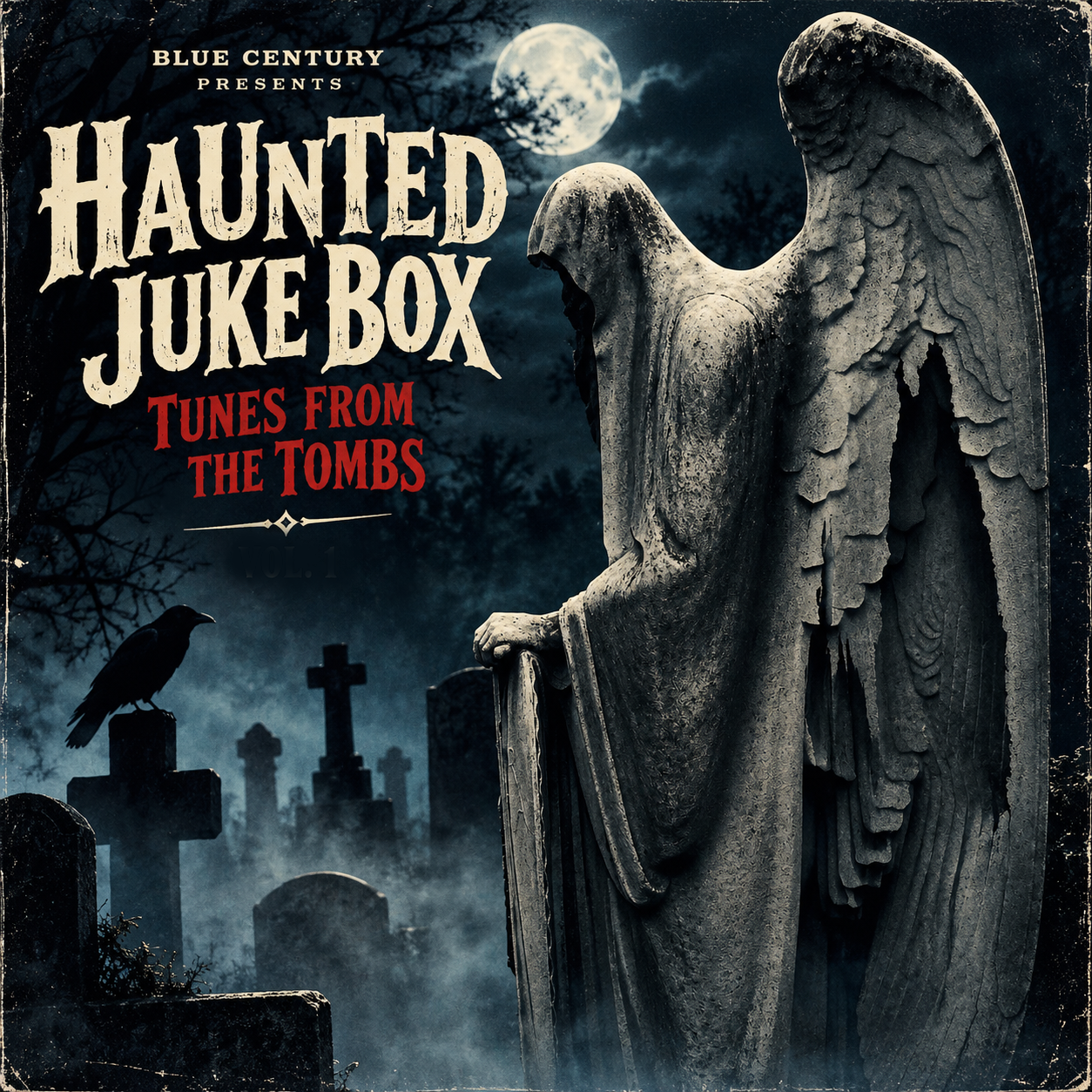
Featuring Leola Manning — “Laying in the Graveyard.”
The inclusion of the recording in that collection was the immediate reason we returned to Manning’s story. What began with an extraordinary title led us back to a far more important subject: the woman who made the record.
RESEARCH, SOURCES AND ACKNOWLEDGEMENTS
This article draws upon contemporary discographical information, genealogical research, Document Records’ own discographical records, and modern scholarship concerning Leola Manning and the Knoxville Sessions.
Particular acknowledgement is due to Dr. Ted Olson and Tony Russell, whose extensive research for The Knoxville Sessions, 1929–1930: Knox County Stomp, published by Bear Family Records in 2016, has been fundamental to the modern understanding of Manning and the Knoxville sessions.
Principal sources consulted:
Bear Family Records — The Knoxville Sessions, 1929–1930: Knox County Stomp
Smithsonian Folkways — Appalachian Blues
Knoxville History Project — Leola Manning
Knoxville History Project — research into “Satan Is Busy in Knoxville”
Knoxville History Project — “Leola Manning and Her Gang,” September 1930
Women in Old Time Music — Leola Manning
East Tennessee Historical Society — Come to Make Records
We are also grateful for personal and local-history recollections concerning Leola Manning, Eugene Ballinger, Bishop Bobby Jean Moore, Howard Armstrong and the East Tennessee communities in which they lived. Particular thanks are due to Bill Claiborne for sharing his recollections and historical material.
Where personal recollections or secondary sources have not yet been independently corroborated, they have been identified as such rather than presented as established documentary fact.
RESEARCH AND ARTICLE PREPARATION
Research compiled by Gillian Atkinson, with additional research, fact-checking and editorial assistance from Mavis Chatsworth, her AI research and writing assistant.
The historical research for this article has been drawn from the sources acknowledged above, together with Document Records’ own discographical knowledge and research gathered specifically for this feature.
We believe in being open about our use of AI. It does not replace original research, historical sources or human judgement. We use it as a research and editorial tool: to help investigate and cross-check information, organise substantial amounts of material, and present detailed music history in a clear and accessible form.
This is particularly valuable to us because Document Records has always had an international audience. We want serious historical research to remain academically responsible while also being readable and accessible to people of different ages, backgrounds and levels of English.
The research, selection of material and final editorial decisions remain ours. Where a fact cannot be satisfactorily established, we would rather say so than allow AI — or indeed any secondary source — to turn uncertainty into fact.
Article prepared for Document Records / Blue Century Records by Gillian Atkinson with her AI assistant and partner, Mavis Chatsworth.