Sinners -Pick Poor Robin Clean: A Song, A Story, and a Mystery of Meaning
May 26, 2025
Gillian
0 Comments
How a 1927 Blues recording found its way into a 21st-century vampire film—and sparked a historical detective story.
When Warner Brothers approached us at Document Records to license “Pick Poor Robin Clean” for their new film Sinners—a brooding modern vampire tale—we expected a straightforward rights request. However, what followed was far more intriguing: a collaboration that led us deep into the shadowy world of music history, identity, and interpretation.
The initial request was for the version recorded by Geechie Wiley and Elvie Thomas, but even that wasn’t straightforward. Was it “Geeshie” or “Geechie” Wiley? And who was Elvie Thomas? Our own releases used the name “Geechie,” as did the original Paramount label. But in the course of research, we uncovered a revealing and touching letter from musicologist Robert “Mack” McCormick to Paul Oliver, the late English blues historian, identifying the elusive singer as Lillie Mae “Geetchie” Wiley and her recording partner as Sister L.V. Thomas.
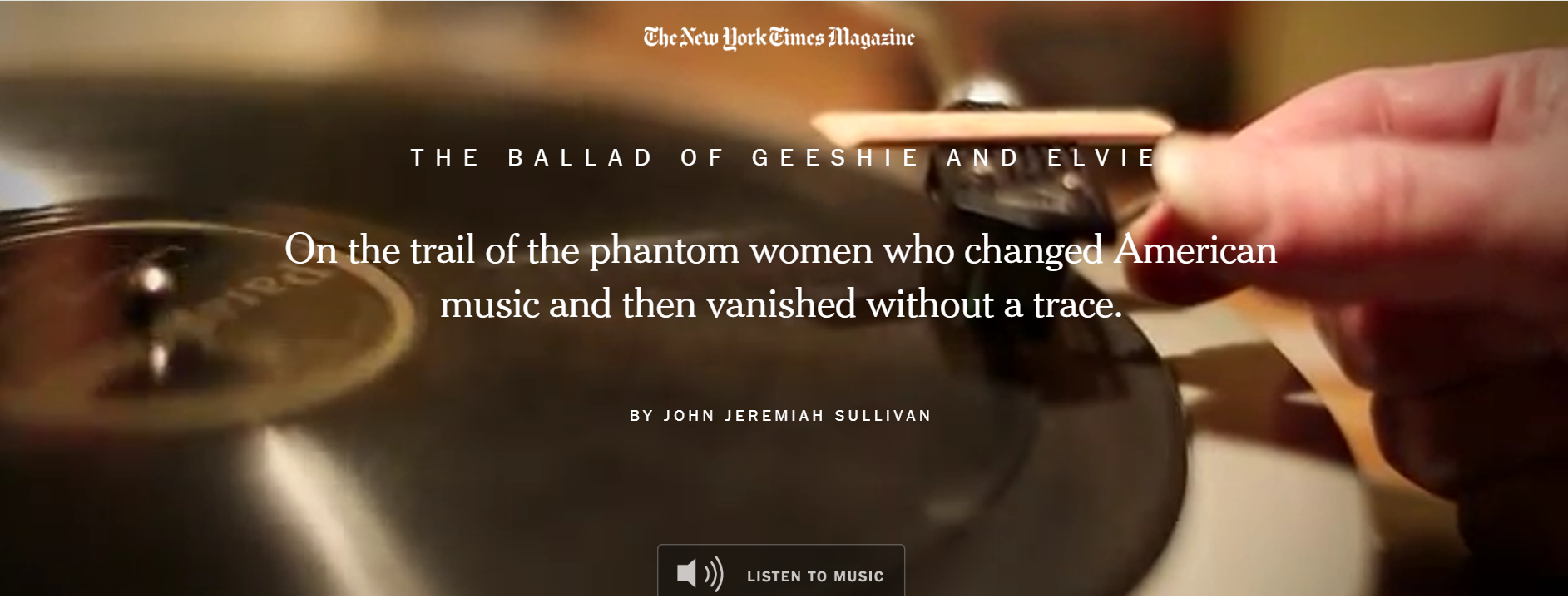
The Ballad of Geeshie and Elvie On the trail of the phantom women who changed American music and then vanished without a trace. Written by John Jeremiah Sullivan Published by The New York Times Magazine, 2014 📰 Read the full interactive article →
This was not just academic nitpicking. For decades, these women were little more than ghost voices etched into rare shellac discs. McCormick’s letter details meeting L.V. Thomas in later life: a gentle, guitar-playing woman, reticent to speak of her past, but a living link to a world many believed lost. With this clarity, we and the Warner music supervisor agreed on the final credit: “Pick Poor Robin Clean” – Performed by Lillie Mae “Geetchie” Wiley and Elvie (L.V.) Thomas – Courtesy of Document Records Ltd.
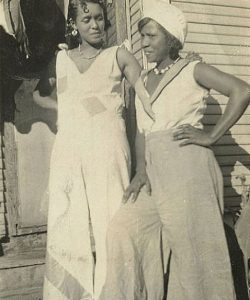
Often shared online as “Geeshie Wiley and L.V. Thomas,” this photograph more accurately shows Zora Neale Hurston (left) in the 1930s. The identity of the woman on the right is unknown. No verified photographs of Wiley.
L.V. “Elvie” Thomas at a Houston nursing home, in a Polaroid photo taken a few weeks before her death in 1979 (Photograph by Robin Wartell).
Whilst we are full of praise for Warners Brothers we are sad to report that Sony Music who licenced the record for its soundtrack persist in accompanying the marketing with this image . We think it embarrassing and disrespectful. We have reached out to the music super involved. She reached out to Sony and Sony replied saying “We suggest Gillian contact Universal’s catalog music group to mention the photo misappropriation and request the photo is removed. Since it’s not our product this is not something have control of including the automatic artist association on DSPs. If we come up with a Universal Music colleague as a starting point, I’ll pass it along.”
In the end, the filmmakers also used a new version sung by actor Jack O’Connell on the official Sinners soundtrack. Artistic choice and quite fitting for the film’s tone. But what a joy it was working with a studio so diligent in getting the history right.
Yet the story of “Pick Poor Robin Clean” doesn’t stop there. The song itself is a riddle. It was first recorded by Virginia-born bluesman Luke Jordan in 1927, whose two versions appear on our -Never Let The Same Bee Sting You Twice – Various Artists – Complete Recorded Works – Blues, Ballads, Rags & Gospel In The Songster Tradition (1927-1938) – Luke Jordan, Mississippi John Hurt, Hambone Willie Newbern.
A different take appears on Mississippi Blues Vol. 1 (1928–1937) (DOCD-5157), by Wiley and Thomas, giving it a wholly different emotional flavour.
Jordan’s version brims with verbal swagger and streetwise bravado:
Get off my money and don’t get funny / ‘Cause I’m a n****, don’t cut no figure…*
The lyrics have sparked debate for decades. While the title evokes imagery reminiscent of the English nursery rhyme “Who Killed Cock Robin?”—a rhyme dating back to at least 1744 and catalogued as Roud Folk Song Index number 494 , there is no concrete evidence to suggest a direct lineage between the two
Is it about gambling? Hunger? Power? The reference to “gambling for Sadie” suggests a dice game, yet the chilling chorus —
I picked his head, I picked his feet / Would’ve picked his body, but it wasn’t fit to eat…
— evokes starvation or even cannibalistic metaphor. Scholar Elijah Wald has noted its ties to minstrel tradition, while Mance Lipscomb spoke of hunting robins during hard times. Others argue it’s rooted in the “dozens,” a verbal sparring tradition full of witty, biting insults.
So is “picking poor robin clean” a metaphor for utter destruction? Emotional exploitation? Taking all one can from the vulnerable? Possibly all of the above.
And that, perhaps, is the point. The magic of the song lies in its ambiguity. Wiley and Thomas’s version, spare and haunted, feels more like mourning than mockery. The gender shift adds another dimension: women singing lines often tied to male braggadocio transforms them into something deeper, more plaintive.
We’d love to hear your thoughts. What do you think the song means?
DOCD-5678 –Blues and Songster Tradition (3 CD Collection)
DOCD-5106 –Sinners & Saints: Complete Recorded Works 1926–1931
This website uses cookies to improve your experience. We'll assume you're ok with this, but you can opt-out if you wish. Cookie settingsACCEPT
Privacy & Cookies Policy
This website uses cookies to improve your experience while you navigate through the website. Out of these cookies, the cookies that are categorized as necessary are stored on your browser as they are essential for the working of basic functionalities of the website. We also use third-party cookies that help us analyze and understand how you use this website. These cookies will be stored in your browser only with your consent. You also have the option to opt-out of these cookies. But opting out of some of these cookies may have an effect on your browsing experience.
Necessary cookies are absolutely essential for the website to function properly. This category only includes cookies that ensures basic functionalities and security features of the website. These cookies do not store any personal information.
Any cookies that may not be particularly necessary for the website to function and is used specifically to collect user personal data via analytics, ads, other embedded contents are termed as non-necessary cookies. It is mandatory to procure user consent prior to running these cookies on your website.