

Papa Charlie Jackson – Complete Recorded Works 1924 – 1934 Vol 3 (1928-1934)
Price range: $0.99 through $19.00
Enjoy instant access to digital downloads for all albums. Our digitized collection offers MP3s, with FLACs in progress.
Note: Not all downloads include booklet notes. CDs where available include extensive booklet notes.
Papa Charlie Jackson
Complete Recorded Works c. August 1924 – c. November 1934
Vol 3: 3rd September 1928 to 26th November 1934
Featuring the recordings of:
Papa Charlie Jackson, vocal / banjo. Ma Rainy and Papa Charlie Jackson, vocal duet; accompanied by Charlie Jackson, banjo. Hattie McDaniels And Dentist Jackson (Papa Charlie Jackson), vocal duet; accompanied possibly by Lovie Austin, piano; Charlie Jackson, guitar. Papa Charlie Jackson, vocal / guitar. Papa Charlie Jackson, vocal / banjo / guitar. Papa Charlie Jackson And Blind Blake: Charlie Jackson, banjo/ speech; Blind Blake, guitar / speech.
Genres: Blues, Country Blues, New Orleans Blues, Louisiana Blues, Early Chicago Blues, Blues Banjo, Country Blues Guitar, Hokum, Female Blues, Blues Guitar, Country Blues Guitar
Abridged from this albums original booklet notes. Paramount seem still to have regarded Papa Charlie Jackson as one of their stars, for his next release found him teamed with the great Ma Rainey (albeit with second billing). These two songs have been described as comic duets, but in fact they give serious treatment to the serious topics of poverty and love. Ma And Pa Poorhouse Blues uses the T. B. Blues tune that Victoria Spivey had made a hit in 1927. The boastful Good Doing Papa Blues reflects a frequent side of Papa Charlies recorded persona, that of the ladies man, effortlessly detaching women from their sweethearts. Similarly boastful, though in more fantastic vein, was the Blind Blake-influenced Jungle Man Blues. Corn Liquor Blues supplied a slow, rather lacklustre flipside, with Jackson sounding unimpressed by his own lyrics, which advertise his bootleg liquor. Dont Break Down One Me is a gentle piece of hokum, using ingenious baseball metaphors, and a tune popular among medicine show entertainers; Hambone Willie Newbern used it for Nobody Knows What The Good Deacon Does, for instance. Baby Please Loan Me Your Heart is a sentimental little piece, with a simple, strummed accompaniment. It was as Dentist Jackson that Charlie next recorded, in duet with the first black person, and so far the only blues singer, to win an Oscar – Hattie McDaniel, later to find fame as Mammy in Gone With The Wind. Hot Papa Blues No. 2 and Take Me Back Blues No. 2 were both remakes of titles which had been issued back-to-back in 1925, although in 1929 they were issued separately. Hot Papa was accompanimentally quite different, replacing high speed banjo flatpicking with a chordal, and very Blind Blakeish, guitar accompaniment. Jackson continues to play guitar on We Cant Buy It No More, which takes close notice of the incipient hokum craze; records by The Hokum Boys, which disguised a variety of lineups, were beginning to appear in early 1929, when this song was waxed, and evidently Papa Charlie Jackson was aware of their hit potential. Also topical in its reference to unemployment was Tailor Made Lover, by La Moore (sic), though it swiftly turns to sexual boasting. Like Take Me Back Blues No. 2, this song has guitar accompaniment; as had happened before, Paramount gave incorrect information on the label. As he had done on Jacksons Blues (see DOCD-5087), Charlie plays a guitar boogie, remarkably prefiguring Leadbelly at one point. Taint What You Do But How You Do It starts off in apparently serious vein, but soon becomes a typically light-hearted piece, with Papa Charlie scatting his way through the verses. The Blind Blake influence was once again in evidence on the more downhearted Forgotten Blues, which features a couple of spectacular bass string slides. Also bass- orientated is Papa Do Do Do Blues, which neatly updates an old line: I can get more women, than a passenger Zeppelin can haul. Ill Be Gone Babe has a sombre lyric, but Jacksons natural exuberance works effectively against its tone, and once again he hits a flashy bass lick. On his next record, Jackson got to work with the man who seems to have been his musical hero for a while, Blind Blake. The meeting was one of musical equals, though; Jackson plays in a higher register than usual to prevent Blakes guitar overwhelming his banjo, and it is he who plays the bugle call on which the two of them improvise, briefly but dazzlingly, in the first part of Papa Charlie And Blind Blake Talk About It. The two men sound thoroughly relaxed, and one has the sense of eavesdropping on a genuine jam session, not of an event staged by Paramount. This was to be Jacksons penultimate record for Paramount. You Got That Wrong and Self Experience are both guitar-accompanied, the former an uncharacteristically sour attack on a girlfriend, the latter a truly remarkable, and surely autobiographical song, whose cryptic title conceals an account of a brush with the police and the courts. Jackson didnt record again until late 1934 and early 1935, when he made four solo sides for Okeh, which were issued, and three with his friend Big Bill Broonzy, which werent. Skoodle-Um-Skoo was a remake of his 1927 recording (see DOCD-5088), played and sung with undiminished enthusiasm; the other three were double entendre pieces, and despite the ingenuity of You Put It In, Ill Take It Out, which turns out to be about M-O-N-E-Y, one feels that Papa Charlie Jackson was a voice from the past. As he himself admits on Whats That Thing Shes Shaking? it was years ago that he had written Shake That Thing.
Chris Smith Copyright 1991 & 2007 Document Records
DOCD-5089
 26. Policy Wheel Blues - Kokomo Arnold
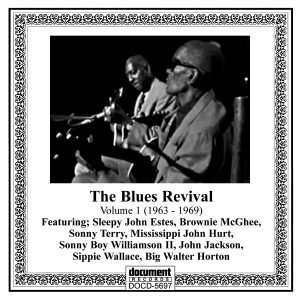 18. Medley: a) When I Lost My Baby b) St. Louis Blues c) Careless Love d) John Henry - Big Walter Horton
 20. Christmas in Heaven - Billy Ward and His Dominoes
 3. Texas Bound Blues - Margaret Thornton
 15. From One To Twelve - Arkansas Shorty
 4. Old Market Street Blues - Jonnie Johnnie Strauss
 22. Mr Santa Claus (Bring Me My Baby) - Nathaniel Mayer
 20. Time Ain't Long (take 1) - Victoria Spivey
 The Earliest Negro Vocal Groups - Various Artists - Complete Recorded Work Vol 5 (1911-1926). MP3 album.
 19. Pail In My Hand - Edna Winston
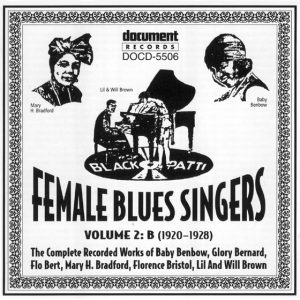 18. Awful Lawdy Lawdy Blues - Aunty Mary Bradford
 13. Take Me Back Blues No. 2 - Papa Charlie Jackson
 11. Back Door Blues - Elzadie Robinson
 1. A Woman's Blues - Irene Sanders
 9. Sister, It's Too Bad - Hezekiah & Dorothy Jenkins
 19. Wade In The Water - Birmingham Jubilee Singers
 18. Wang Wang Blues - Mal Hallet's Orchestra
 24. The Grace And Beauty Rag (Broadcast) - Knocky Parker
 3. The Buffalo Skinners - Pete Harris