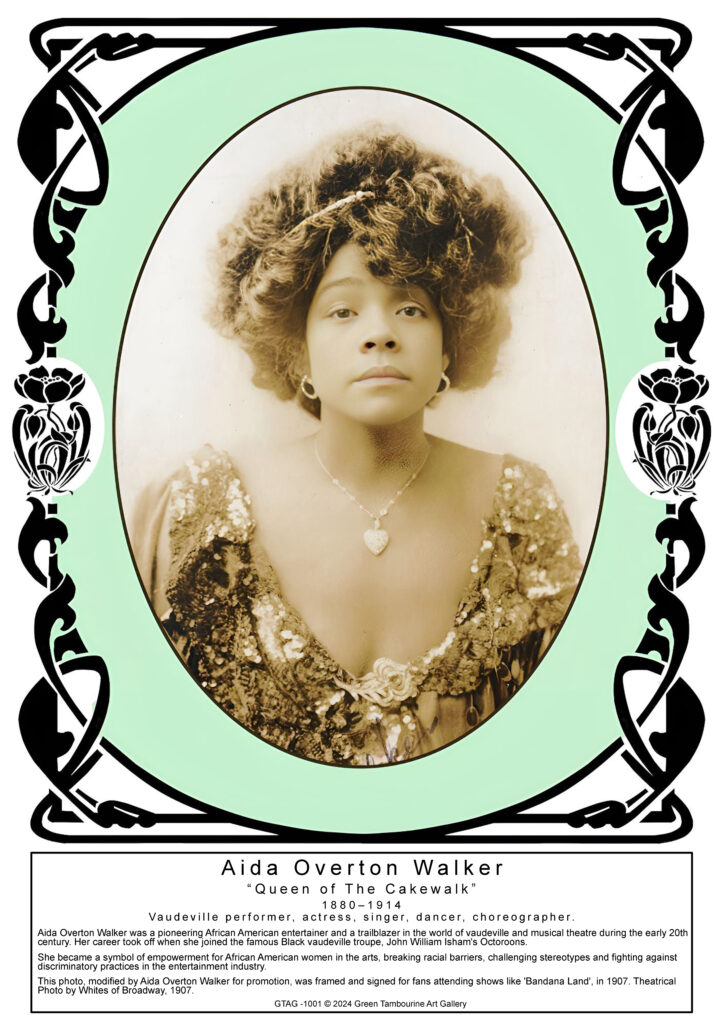
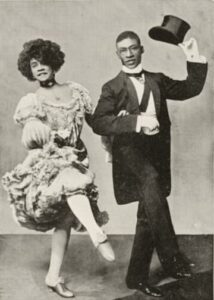
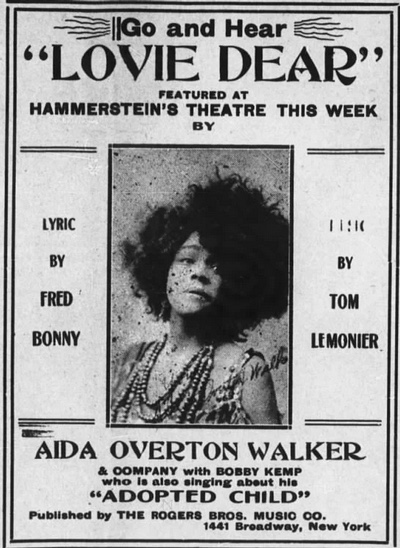
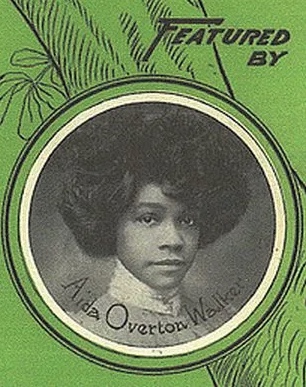
During the vaudeville era from the 1880s to the 1920s, over 25,000 performers took to its stages, making it one of the most popular forms of entertainment in America In this world of vaudeville, where music, dance, and comedy intertwined on stage, one star shone with exceptional brilliance: Aida Overton Walker. Known as the “Queen of the Cakewalk,” she danced her way into the hearts of many, becoming an icon of her time. But why do we celebrate her, you might wonder? Let’s delve into the life of this remarkable woman and discover her unforgettable contributions to the arts and society. You can buy this image as a Art Print , Greetings Card or Mug from our website
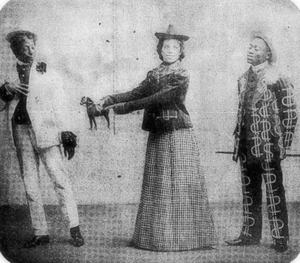
Ada Overton Walker, a virtuoso in buck-and-wing and cakewalk, is recognized as one of the first choreographers on the American stage. Born Ada Wilmon Overton on St. Valentine’s Day 1880 in Greenwich Village, New York City, she was the second child of Pauline Whitfield, a seamstress, and Moses Overton, a waiter. Before her parents decided she would take official dance lessons from Mrs. Thorp in midtown Manhattan, she danced in the streets with a hurdy-gurdy. In 1895 at the age of fifteen her career began when she joined John William Isham’s Octoroons, one of the most successful black touring groups of the time and where she probably first encountered Bert Williams and George Walker by 1987 she was the part of the Black Patti’s Troubadours.
Image Scene from a comedy sketch in The Octoroons by John W. Isham. Stella Wiley (centre) offers a toy horse to Walter Smart (left). George Williams stands at the right. Uncredited circa 1896
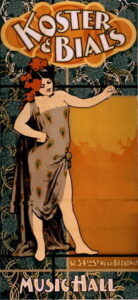
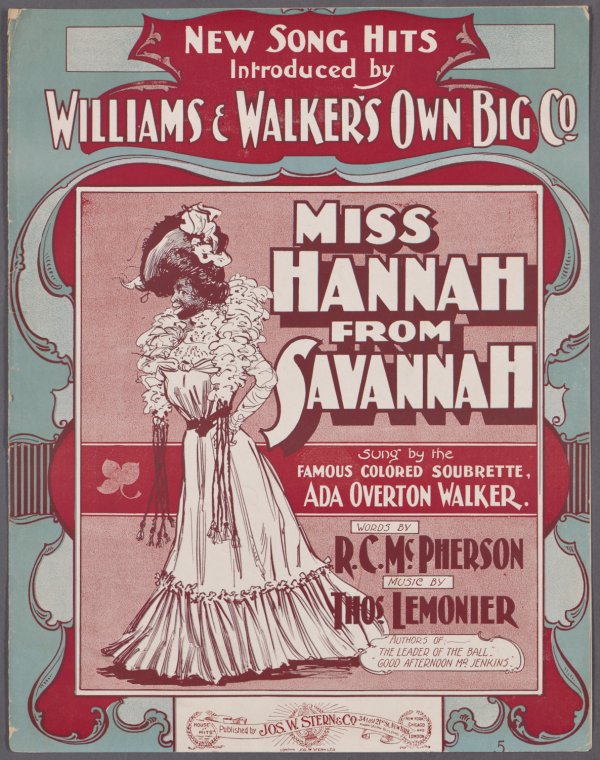
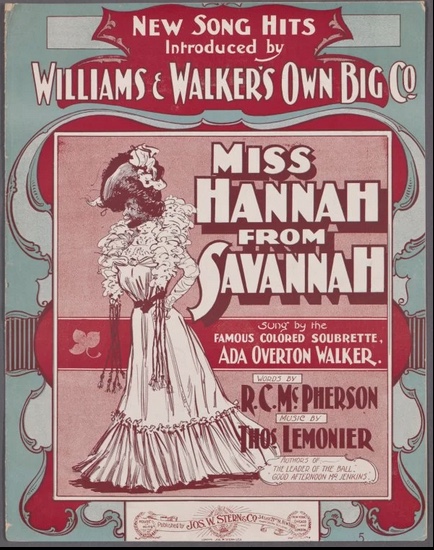
Overton joined Williams and Walker at Koster and Bial’s in 1898 for the second production of In Gotham, a song and dance revue with forty performers. She later created Overton and Halliday, the largest sister act of the period, with Grace Halliday. Overton and Halliday played the Honolulu Belles in Williams and Walker‘s The Policy Players (1899), and Overton resolved to become a soloist with larger roles. In The Sons of Sam (1900), she sang and danced “Miss Hannah from Savannah” and “Leading Lady.”
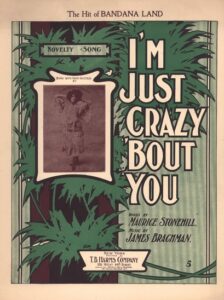
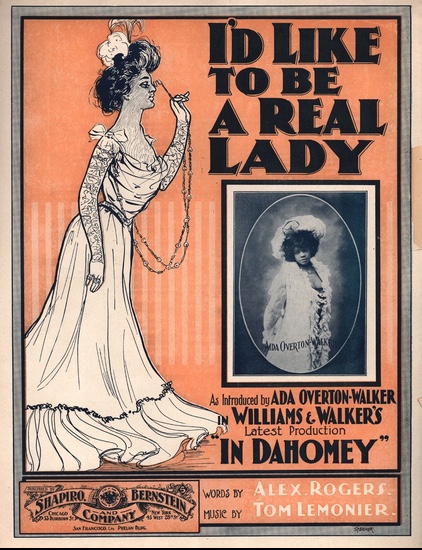
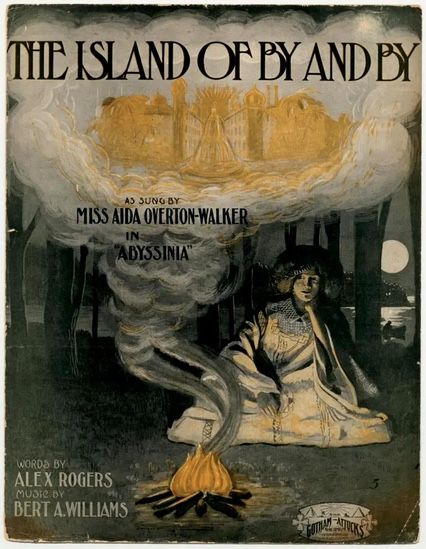
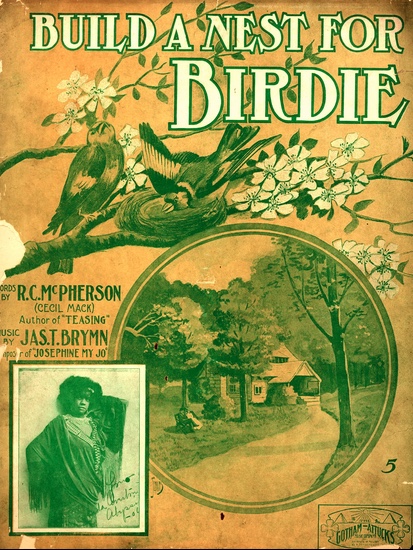
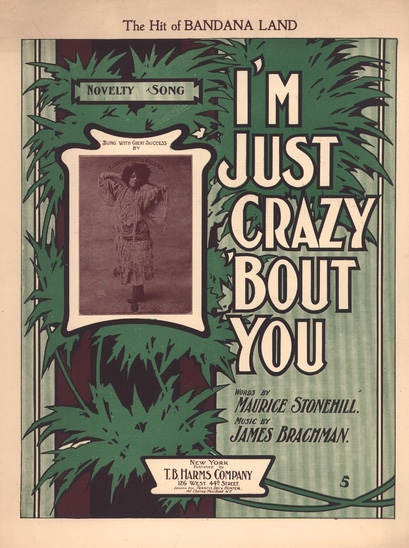
According to James Weldon Johnson’s memoirs, Ada Overton “had a low-pitched voice with a natural sob, which she used to narrate a story over a song.” Tom Fletcher said she was a dancer “who could do almost anything, and no matter whether it was a buck-and-wing, cakewalk, or even some form of grotesque dancing, she lent the performance a neat gracefulness of movement which was unsurpassed by anyone.” Sadly for us Aida Overton Walker was never recorded but a selection of the sheet music most her most popular songs appears at the end of this blog.
Williams and Walker in boaters. Uncredited image circa 1907.
Photographer unknown. Aida Overton Walker and George Walker cakewalk in In Dahomey. The Tatler (London), no. 98, May 13, 1903.
Overton married George Walker in 1899 and became the preeminent cakewalking pair of the new century. In the cakewalk, they found a defining black modernist expression—a high art worthy of royalty, the white elite, and the concert stage. Williams and Walker‘s 1903 play In Dahomey was one of the first to change the cakewalk. Ada was soon renamed Aida, after the Haitian loa (spirit) of fertility, rainbows, and snakes and Danbala’s wife. Ada and George’s cakewalk in that play was unmatched. Carl Van Vechten, a writer and photographer, wrote of the act, “The line, the grace, the assured ecstasy of these dancers, who bent over backward until their heads almost touched the floor, a feat demanding an incredible amount of strength, their enthusiastic prancing, almost in slow motion, have never been equaled in this particular revel, let alone surpassed.”
It had a tour in the United Kingdom, followed by a highly successful tour of the United States, which lasted a total of four years. It was the first American black musical to be performed abroad.
Dahomey command performance before Edward VII at Buckingham Palace in 1903 was in the royal family’s private apartments. British high society gushed over cakewalking like the royal family. When Overton Walker returned to New York, she used her revised cakewalk choreography to enter affluent white society. She called cakewalk “the modern cakewalk.” She updated the dance from its roots in lower-class black “dance halls” that evoked slave culture to a modern concert hall classic.
George Walker, and other members of the cast dancing in Dahomey at the Shaftesbury Theatre in 1903
The musical was revived on Broadway, opening at the Grand Opera House on August 27, 1904 and closing on September 10, 1904 after 17 performances. Bert Williams (as Shylock Homestead), George Walker (as Rareback Pinkerton) and Aida Overton Walker (as Rosetta Lightfoot) reprised their roles.
Overton Walker used the performing arts to help middle-class blacks achieve upward mobility as part of the “racial uplift” movement. Many turn-of-the-century African American women became social activists and feminists, influenced in part by W. E. B. Dubois’s idea that the “talented tenth” of African Americans rose and drew everything worth saving up to their vantage point. That dedication was formally reaffirmed when Overton Walker claimed that her performances were a reaction to the long-held perception of actresses as morally unfit.
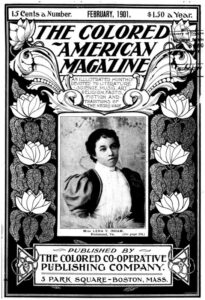
In an October 1905 article in The Colored American Magazine, Overton Walker her belief that the performing arts could have an effect on race relations, stating that, “I venture to think and dare to state that our profession does more toward the alleviation of color prejudice than any other profession among colored people.”
In 1908, Overton Walker appeared in Williams and Walker‘s Bandanna Land, and her beautiful dancing drew recognition.
A new solo for her, “the Dancing of Salome,” was added shortly after Bandanna Land debuted.
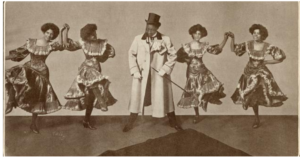
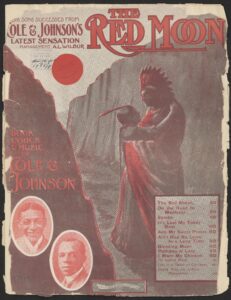
George Walker, who played Bud Jenkins onstage in Bandanna Land, became ill one evening in 1908. He was later diagnosed with syphilis. He departed the show in 1980, and his role was reworked for Overton Walker, who dressed in showy masculine attire and sang his songs. While renewing her contract with Williams and Walker, she joined the cast of Bob Cole and J. Rosamand Johnson’s Red Moon, in which she performed two songs, “Pheobe Brown” and “Pickaninny Days.” She then debuted at the American Theatre in 1909 with a vaudeville show starring herself and eight other females of colour.
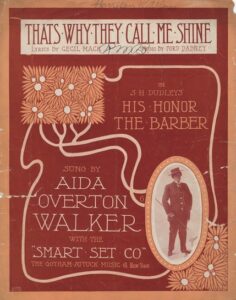
By July 1911, six months after her husband’s death, Overton Walker had formed a new vaudeville act with one male and eight female dancers, in which she sang “Shine” as a male impersonating her late husband and performed the new dance craze “The Barbary Coast” in close embrace with her new male partner.
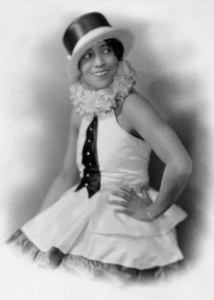
Gee, Lottie – Singer, USA Portrait in costume – Published by: ‘Berliner Illustrirte Zeitung’ 23/1925
From 1912 until her death in 1914, Overton Walker continued to choreograph for two black female dance groups, the Happy Girls and the Porto Rico Girls.
Dancers included Lottie Gee, who would later star in the musical revue Shuffle Along (1921), and Elida Webb, who would star at the Cotton Club in the 1920s.
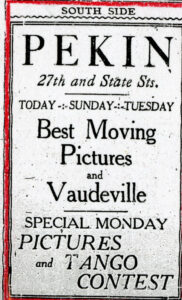
In 1912, Overton Walker performed “Salome” in a stunning vaudeville production at Oscar Hammerstein’s Victoria Theatre in New York. She also joined Bert Williams for the annual Frog’s Frolic, when she shared the stage with Bill Robinson. Overton Walker’s ambition of producing her own play came true in 1913, when she led a cast of twelve at Chicago’s Pekin Theatre.
In 1914, she shifted from African-style dance to ballroom dance in her vaudeville act with new partner Lackaye Grant. At the tango picnic in July of that year, she and partner Grant performed their ballroom dancing act to great applause. The tango picnic was Overton Walker’s final public appearance. She died in New York on 11 th October 1914 from kidney disease.
The leading African American female theatre artist, Overton Walker, was inspired by African American indigenous material and translated it to the modern stage before Katherine Dunham and Pearl Primus. She asserted her feminine presence on the American theatrical stage with her solo work and the female chorus’s unity and precise choreographies. By negotiating narrow white definitions of appropriate black performance with her own version of black specialisation and innovation, Overton Walker established a black cultural identity onstage that helped African American musical artists gain professional concert acceptance.
Authored by: Gillian Atkinson from Document Records
Graphics by: Gabriela Teodora Vâlceanu
This website uses cookies to improve your experience. We'll assume you're ok with this, but you can opt-out if you wish. Cookie settingsACCEPT
Privacy & Cookies Policy
This website uses cookies to improve your experience while you navigate through the website. Out of these cookies, the cookies that are categorized as necessary are stored on your browser as they are essential for the working of basic functionalities of the website. We also use third-party cookies that help us analyze and understand how you use this website. These cookies will be stored in your browser only with your consent. You also have the option to opt-out of these cookies. But opting out of some of these cookies may have an effect on your browsing experience.
Necessary cookies are absolutely essential for the website to function properly. This category only includes cookies that ensures basic functionalities and security features of the website. These cookies do not store any personal information.
Any cookies that may not be particularly necessary for the website to function and is used specifically to collect user personal data via analytics, ads, other embedded contents are termed as non-necessary cookies. It is mandatory to procure user consent prior to running these cookies on your website.