“Fiddlin’ John Carson: The First Voice of Country Music”

🎻 Fiddlin’ John Carson: The Man Who Fiddled America Crazy

Introduction
Born on March 23, 1868, Fiddlin’ John Carson sparked the fire that became commercial country music. He was more than a fiddler — he was a moonshiner, a showman, and a radio pioneer.

In 1923, Carson recorded “The Little Old Log Cabin in the Lane” and “The Old Hen Cackled and the Rooster’s Going to Crow.” These songs didn’t just sell — they launched country music on record. Thousands bought them.

Carson didn’t just play the fiddle. He lived it. He sang alongside his beloved hound dog, Old Trail, and trained his daughter Rosa Lee (later known as Moonshine Kate) to become one of the first female stars in country music.

Until the very end, music never left his hands. John Carson died with a fiddle in his arms and little to his name — except a legacy that still echoes in every country tune today.

Document Records is proud to have reissued all of Fiddlin’ John Carson’s recorded works .
Document has also created poster  and prints  to accompany the music.

Here’s  Fiddlin ‘John Carson’s story 

Origins and Early Life

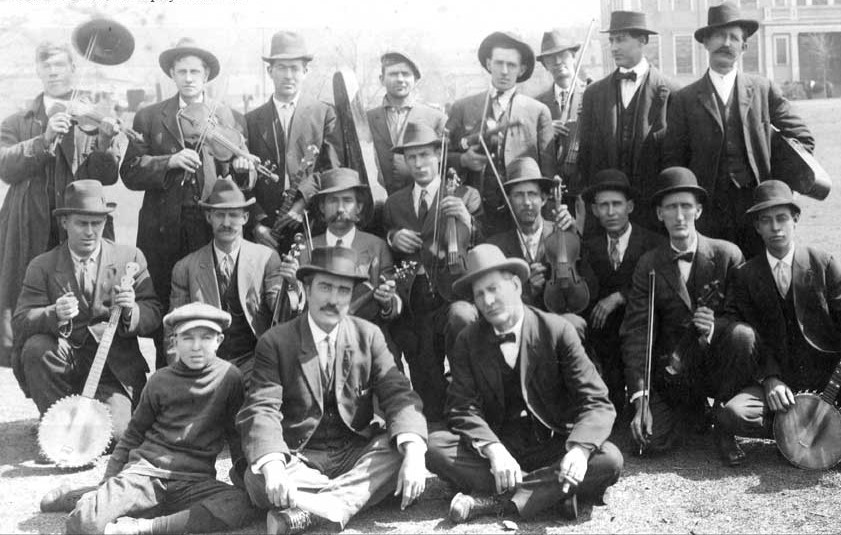
Group photo of fiddlers and banjo players at the 1914 Georgia Old-Time Fiddlers’ Convention, likely including Gid Tanner and Fiddlin’ John Carson in the back row.
Group photograph from the 1914 Georgia Old-Time Fiddlers’ Convention, held in Atlanta. Believed to include Gid Tanner (with his hat on the fiddle) and Fiddlin’ John Carson standing beside him in the back row. These gatherings were crucial to the evolution of southern music, blending competition, community, and cultural preservation. Attribution based on visual identification. Public domain image.

Born in 1868 near Fannin County, Georgia, Fiddlin’ John Carson grew up on a farm with very little formal schooling. He only attended classes for a few days.

In his teens, Carson began teaching himself the fiddle. He used an old Stradivari-copy violin brought from Ireland. According to family stories, he had already learned to play “Old Dan Tucker” by the time he returned home from a visit to his grandfather — the man who gave him that very fiddle.

Before music took centre stage, Carson worked wherever he could. He laboured as a farmer, a railroad hand, a horse jockey, and even a moonshiner.

Eventually, he found his way to the stage. He began performing in travelling minstrel shows and soon became a local favourite across Georgia.

From Jailhouse to Microphone: The Rise of a Legend

Carson’s life changed forever thanks to Polk C. Brockman, an Atlanta furniture dealer and OKeh Records distributor. After spotting Carson in a newsreel, Brockman arranged a recording session with Ralph Peer, a talent scout for OKeh.

Peer wasn’t impressed. He described Carson’s voice as “pluperfect awful.” Still, he allowed the session to go ahead as a filler.

On June 14, 1923, in a loft on Nassau Street in Atlanta, Carson recorded two songs: “The Little Old Log Cabin in the Lane” and “The Old Hen Cackled and the Rooster’s Going to Crow.”

Initially, the records were intended for local release. But they sold out instantly. By the end of the month, Peer had ordered thousands more.

Carson was quickly summoned to New York, where he recorded a dozen more tracks. With that, he became the first commercially successful country recording artist.

His debut alone sold over 500,000 copies. Soon after, he signed an exclusive recording contract. Between 1923 and 1931, Carson recorded more than 165 songs. He was often backed by his band, the Virginia Reelers, and frequently performed alongside his daughter Rosa Lee — known to audiences everywhere as Moonshine Kate.

In 1899, Carson landed in jail for moonshining. But the story took a twist. According to Carson, a local sheriff struck a deal: win a fiddle contest, and walk free. Carson won — and kept winning, taking the title eight years in a row. This mix of charm, rebellion, and raw musical talent would define his life.

By 1922, radio was on the rise. When Atlanta’s WSB station opened, Carson showed up uninvited, fiddle in hand, and asked to play. He launched into a spontaneous mountain music set that, according to staff, continued “until exhaustion set in.” The phones rang off the hook. Listeners were spellbound.

The performance made history. Carson became WSB’s most beloved entertainer — and the first country musician to find true success on radio.

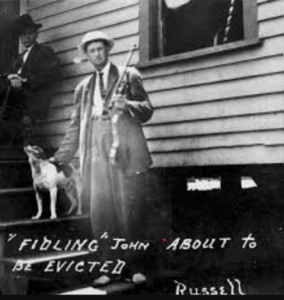
Fiddlin’ John About to Be Evicted 1914
Fiddlin John About to be evicted ..or so it is said
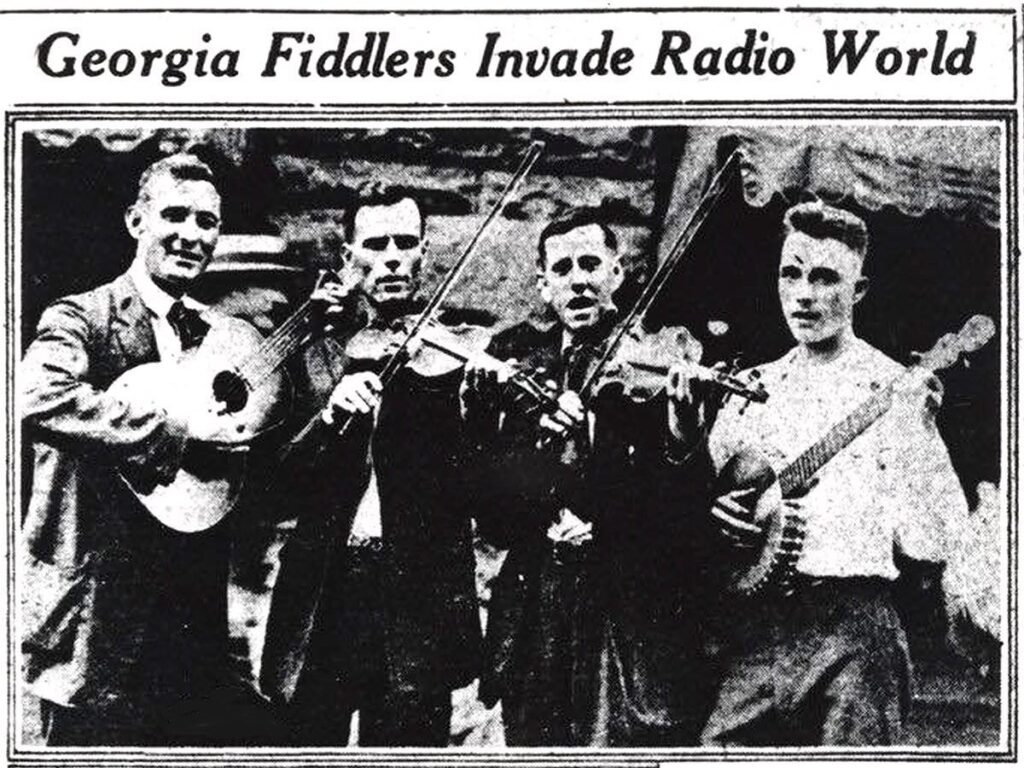
T.M. “Bully” Brewer, Earl Johnson, Fiddlin’ John Carson, and L.E. Akin pictured before their historic 1922 country music radio debut on WSB Atlanta.
Country music’s radio debut: Brewer, Johnson, Carson, and Akin made history on September 9, 1922, when WSB Atlanta broadcast their performance — sparking a flood of telegrams from thrilled listeners. Image from The Atlanta Journal, September 10, 1922.
Vintage poster for the 1920s Gordon County Fiddlers’ Convention, featuring Fiddlin’ John Carson and Moonshine Kate at the Calhoun Courthouse.
Fiddlers’ Convention Poster – Calhoun Courthouse with John Carson & Moonshine Kate
Newspaper collage featuring Fiddlin’ John Carson in 1922, highlighting his rise to national fame through early radio broadcasts.
This 1920s editorial layout celebrates the rise of Fiddlin’ John Carson as radio’s first country music star. His 1922 WSB Atlanta performance brought rural mountain music to living rooms across the nation. Image reproduced from a contemporary newspaper feature.

A Recording Session That Changed Everything

In 1923, everything changed. Polk C. Brockman, an Atlanta furniture dealer and OKeh Records distributor, saw Carson in a newsreel and knew he had something special. He arranged a recording session with OKeh’s Ralph Peer.

Peer wasn’t impressed. He famously described Carson’s raw voice as “pluperfect awful.” Still, he let the session go ahead — just to fill time.

On June 14, 1923, in a loft on Nassau Street, Carson recorded two songs: The Little Old Log Cabin in the Lane and The Old Hen Cackled and the Rooster’s Going to Crow. The records were meant for local release only — but they sold out within days. By the end of the month, Peer had ordered thousands more.

Soon after, Carson was invited to New York. He recorded twelve more sides and signed an exclusive contract. His debut alone sold over 500,000 copies.

Between 1923 and 1931, Carson recorded more than 165 songs. He often performed with his band, the Virginia Reelers, and with his daughter Rosa Lee — better known as Moonshine Kate.

Maroon OKeh record label for “The Little Old Log Cabin in the Lane” by Fiddlin’ John Carson, recorded in Atlanta, Georgia.
The original OKeh label for Fiddlin’ John Carson’s historic 1923 recording of “The Little Old Log Cabin in the Lane”, widely considered the first commercial country music record. Issued as OKeh 4890-A and recorded in Atlanta, the release sold rapidly and launched Carson to national fame. Label design courtesy of OKeh Records / Public domain.
OKeh record label for “The Kickin’ Mule” by Fiddlin’ John Carson, catalogue number 40071-B.
Label for “The Kickin’ Mule,” a spirited fiddle solo by Fiddlin’ John Carson, released on OKeh 40071-B. Known for its humour and liveliness, the tune was a crowd favourite in Carson’s stage performances. Original OKeh label. Public domain
OKeh label for “Dixie Cowboy” by Fiddlin’ John Carson, catalogue number 7004-A, featuring vocal chorus and fiddle solo.
The OKeh label for “Dixie Cowboy,” an evocative fiddle-and-vocal track from Fiddlin’ John Carson. Songs like this blended frontier imagery with rural balladry, forming the lyrical foundation of country music. OKeh Phonograph Corporation label. Public domain.

Moonshine Kate: A Trailblazer in Her Own Right

Born in Atlanta in 1909, Rosa Lee Carson — later known as Moonshine Kate — carved out her own legacy in early country music. She was one of the genre’s first female comedians and a true pioneer in her own right.

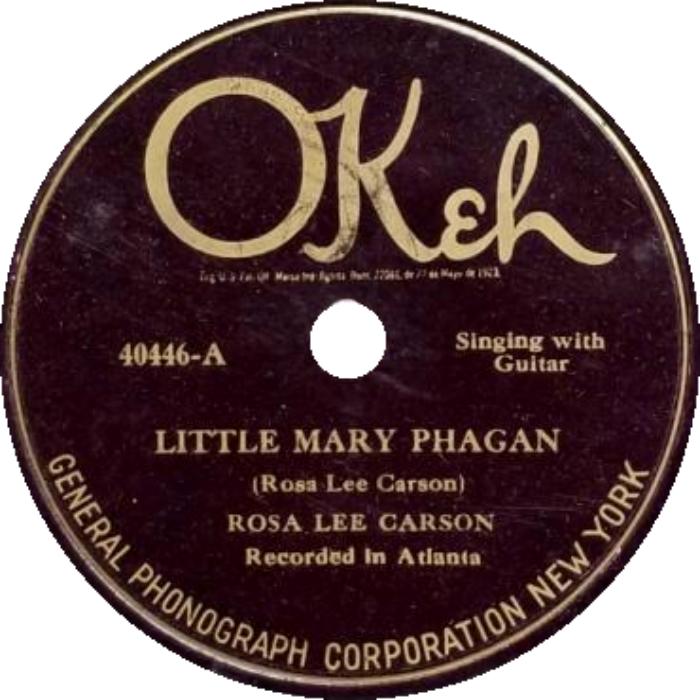
The daughter of Fiddlin’ John Carson and Jenny Nora Scroggins, she joined her father on stage at just five years old. Singing, dancing, and playing both guitar and banjo, she performed at rallies, radio shows, and live events across Georgia. By fifteen, she was recording for OKeh Records. Her early solos included Little Mary Phagan and The Lone Child. Between 1925 and 1934, she appeared on over 100 recordings — both duets and solo performances.

In 1928, OKeh talent scout Polk Brockman gave her the stage name “Moonshine Kate.” It was a playful nod to her mountain image and the skits she performed alongside her father. She embraced the nickname proudly and used it for the rest of her career.

When the Depression slowed record sales, Kate continued performing with her father at political rallies. She later worked for the Atlanta Department of Recreation, married in 1944, and ran a fishing lodge near Lake Seminole. She also became a trusted source of oral history, contributing to the 1987 biography Fiddlin’ Georgia Crazy.

In 1983, she and her father were honoured as inaugural inductees into the Atlanta Country Music Hall of Fame. She passed away in 1992, leaving behind a fearless, banjo-strumming legacy as one of country music’s founding daughters.

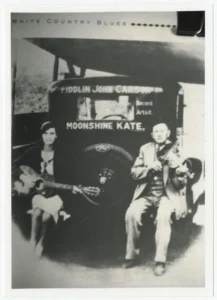
Fiddlin’ John Carson and Moonshine Kate on the Tailboard of a Touring Car
Fiddlin’ John Carson and Moonshine Kate seated with their instruments on the tailboard of a black touring car, proudly marked with their names and titles. Courtesy of Hargrett Rare Book and Manuscript Library, University of Georgia Libraries
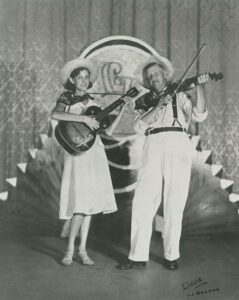
Fiddlin’ John Carson and his daughter, Moonshine Kate, performing on stage in matching straw hats and vintage attire, circa 1927.

The Politics of Performance

  Moonshine Kate and the Song That Shaped a Controversy

In 1925, fifteen-year-old Rosa Lee Carson—known to audiences as Moonshine Kate—recorded “Little Mary Phagan,” one of her earliest solo songs. The track captures the raw, emotional storytelling style that defined early country music. Her father, Fiddlin’ John Carson, wrote the song in 1915. He based it on the Leo Frank case, one of Georgia’s most infamous and controversial legal trials.

Moonshine Kate toured and performed from a young age alongside her father and his band, the Virginia Reelers. She became one of the first women to record country music and emerged as one of the most prolific country artists of the 1920s. 

The Story Behind “Little Mary Phagan”

The song tells the tragic tale of Mary Phagan, a 13-year-old girl who was murdered in 1913 after picking up her pay from an Atlanta pencil factory. Factory superintendent Leo Frank, a northern-born Jewish man, was arrested and convicted of the crime. The case stirred intense anti-Semitic sentiment across Georgia. Many now believe that the state’s case lacked clear evidence and that Frank was innocent. Some historians suspect that the key witness—James Conley, the factory janitor—may have been the actual killer.

After reviewing the case, Governor John Slaton commuted Frank’s death sentence to life in prison. His decision sparked outrage. A lynch mob, calling themselves the Knights of Mary Phagan, dragged Frank from his cell and murdered him in 1915. The same group would later help re-establish the Ku Klux Klan in Georgia.

A Song That Echoed a Divided Nation  
This except is taken from Documenting the American South (DocSouth), a digital publishing initiative sponsored by the University Library at the University of North Carolina at Chapel Hill, 

Rosa Lee Carson’s 1925 song “Little Mary Phagan” exemplifies the country music of the time. Carson, who was better known as Moonshine Kate, a nickname meant to “enhance her hillbilly image,” began performing and traveling at a young age with her father, Fiddlin’ John Carson, and his country band, the Virginia Reelers (“Moonshine Kate”).
Carson was “one of the first women to record country music” and “one of the most extensively recorded country stars of the 1920s” (“Moonshine Kate”).
“Little Mary Phagan” was one of her earliest solo attempts, recorded in 1925 when Carson was fifteen.
The song was written by her father in 1915 as a response to the Leo Frank case, “one of the most notorious and highly publicized cases in the legal annals of Georgia” (“Leo Frank Case”).
In 1913, 13-year-old Mary Phagan was murdered in an Atlanta pencil factory after picking up her paycheck from factory superintendent Leo Frank.
Later that evening, the night watchman found her lifeless and brutalized body in the cellar; rumors spread quickly that Phagan had been sexually assaulted.
Leo Frank, who was a northern Jew, was arrested and tried for Phagan’s murder, despite a lack of clear evidence and the changing testimony of the main witness, a janitor at the factory; indeed, many now suspect that the “witness” was actually the killer.
Frank was found guilty amid much local fervor and anti-Semitism, and subsequent appeals failed.
Governor John M. Slaton reviewed the case, the appeals, and the scene of the crime, and found Frank likely to be innocent; he “commuted the sentence . . . to life imprisonment, assuming that Frank’s innocence would eventually be fully established and he would be set free” (“Leo Frank Case”).
Riots in Georgia followed the decision and Slaton was forced to declare martial law. Nonetheless, a lynch mob removed Frank from his cell and hanged him in Phagan’s hometown in 1915. Members of the mob, the “Knights of Mary Phagan,” would join with other men in 1915 to found a chapter of the Ku Klux Klan (Worthy).

Carson’s rendering of the song, despite the ending no longer being audible, reflects the sensationalist rhetoric and emotions that surrounded this case. “Little Mary Phagan,” according to Carson, went forth to “get her little pay” after she “kissed her mother good-bye.” Instead, she is met by Leo Frank “with a blues we hardly know” and told “Lil’ Mary, now you go home no mo.” Playing up the innocence and femininity of Phagan in order to condemn Frank, Carson shows Phagan falling “upon her knees” and pleading “because she was virtuous.” Frank is described as hitting her “across the head” as “the tears rolled down her rosy cheeks, the blood flowed down her back.”


On Sunday, March 7, 1982, The Tennessean printed a 10-page special section titled “Justice Betrayed: A Sin of Silence,” . The main story from that special section, written by Jerry Thompson, Robert Sherborne and Frank Ritter under the headline “An Innocent Man Was Lynched,” is republished here.

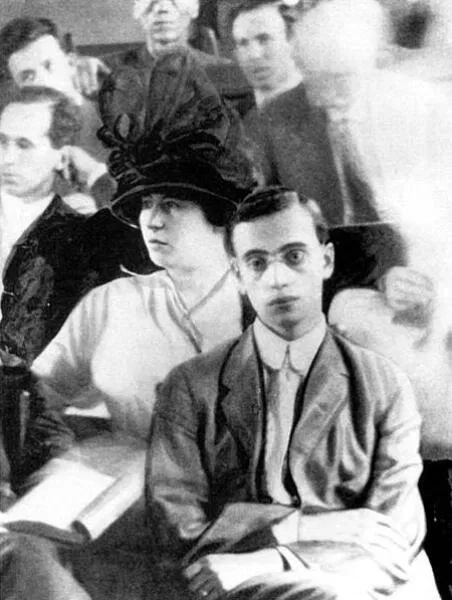
Leo Frank seated beside his wife Lucille in a crowded courtroom during his 1913 trial for the murder of Mary Phagan
Leo Frank sits beside his wife Lucille during his 1913 trial in Atlanta, Georgia. The case became one of the most controversial in American legal history, ending in Frank’s lynching after his death sentence was commuted.
Portrait of Mary Phagan, a young girl with bows in her hair, taken shortly before her tragic death in 1913
Mary Phagan was only thirteen when she was found murdered at the Atlanta pencil factory where she worked. Her death led to the wrongful conviction and eventual lynching of Leo Frank, in one of the most infamous miscarriages of justice in American history.

Decline and Legacy

As has been said in the excellent  blog ” Okeh, Okay, But Fiddlin’ John Carson Was the Devil?

“The newspapers covered Carson and his many children regularly. He and his sons were often jailed. One son, Grady, was publicly accused of beating his wife and was later killed in a bar fight. A daughter was killed in a car accident, and another daughter accidentally drank Lysol but survived (it’s entirely possible, given the times, that she thought it was moonshine?)” 

As music tastes changed in the 1930s, Carson’s raw, archaic style fell out of fashion. The Depression dried up record sales. Though he recorded again in 1934 for Bluebird Records, he never regained the prominence of his earlier years. He continued performing at political events and started a modest fishing lodge, but his days as a household name were over.

He died in 1949, nearly penniless, holding his fiddle in his arms. But his legacy was enormous. Poets like Stephen Vincent Benét paid tribute to his style in verse, and his showdown with fiddler Lowe Stokes in 1924 became the inspiration for tales like “The Devil Went Down to Georgia.”

Today, Carson is recognized not only as the first commercial country music recording artist but also as the genre’s first radio star, its first concert fiddler, and its first true folk celebrity.

Newspaper clipping about Fiddlin’ John Carson and his sons being jailed for disorderly conduct in 1935
Fiddlin’ John Carson and two of his sons were jailed after a street altercation in 1935, according to this report from the Atlanta Constitution.
Fiddlin’ John Carson playing the fiddle in his later years
Fiddlin’ John Carson later in life, still devoted to the instrument that defined his legacy.
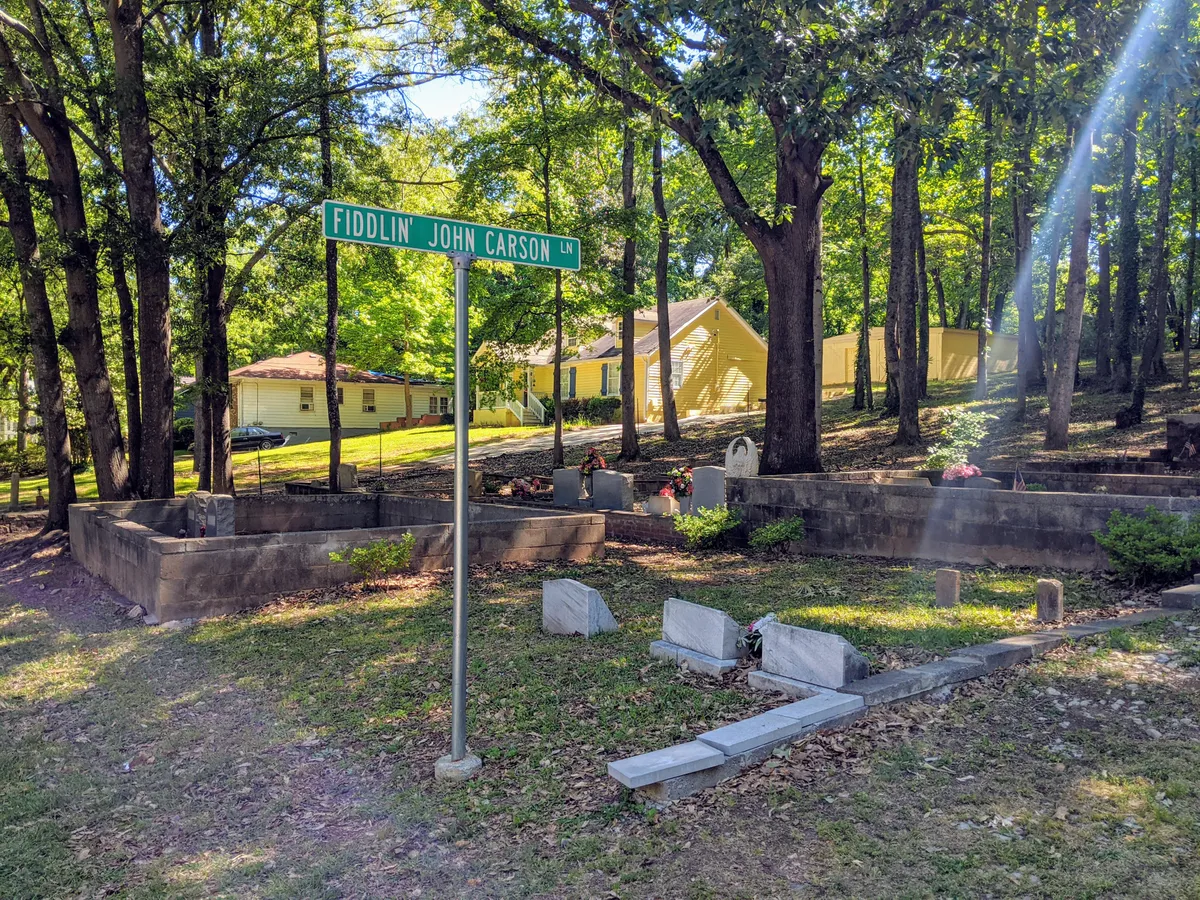
Gravesite of Fiddlin’ John Carson in Atlanta, Georgia, with a street sign reading “Fiddlin’ John Carson Ln” amidst trees and gravestones.
Fiddlin’ John Carson’s gravesite in Atlanta, Georgia, marked by a dedicated street sign honouring the pioneering country musician.

A Legacy Preserved

Though often overlooked by the Nashville establishment, Carson’s influence reverberates through every fiddle tune, every high-lonesome ballad, and every string band performance that followed. His recordings capture a raw, unfiltered moment in America’s musical heritage — a world of jugs, dogs, jailhouse ballads, and political fiddling.


Document Records is proud to have reissued the complete recordings of Fiddlin’ John Carson, offering his full catalogue, lovingly remastered, to a new generation of listeners.


In addition, we have created exclusive art prints and posters featuring the original OKeh Records advertising that helped launch Carson’s legend. These pieces are available only from Document and celebrate a pivotal figure in the story of country music.

🎻 Explore the complete legacy of Fiddlin’ John Carson — and the history he helped create — only at Document Records.

🎼 Explore the Legacy of Fiddlin’ John Carson

🎻 Discover the Legacy of Fiddlin’ John Carson

Document Records is proud to present the complete recorded works of Fiddlin’ John Carson — a monumental 7-volume collection that brings his voice, fiddle, and fierce spirit back to the ears of the world.

In celebration of his legacy, we’ve also created a series of exclusive fine art prints and posters, featuring rare original OKeh advertising materials from the 1920s — a visual tribute to one of the founding figures of American country music.

🎧 Browse the full collection and discover the man whose music helped shape the course of American music history.

🛒 Just click on the image below to Browse, Listen, or Shop the Fiddlin’ John Carson Collection.

Seven volumes of the Complete Recorded Works of Fiddlin’ John Carson [1923–1934 Series], available from Document Records.
The full seven-volume Complete Recorded Works of Fiddlin’ John Carson (1923–1934) series, available exclusively from Document Records. A definitive collection of a country music pioneer’s legacy.

1924 OKeh Records Advert – Carson & Whitter

We are proud to offer three beautifully repurposed artworks featuring Carson & Whitter, taken directly from an original 1924 OKeh Records advertisement. These pieces celebrate the raw spirit of early American roots music and are available in the following formats:

Available Formats:

  • 🖼 A3 PosterUnframed, lightweight and ideal for casual display
    $27

  • 🖼 A3 Fine Art PrintPrinted on archival quality paper for vibrant, lasting colour
    $49.99

  • 🖼 Mounted Fine Art Print (11 x 14 inches)Ready to frame, beautifully presented on a sturdy mount board
    $49.99
    Click on the image to Browse or Shop

Vintage 1924 OKeh advertisement featuring Fiddlin' John Carson, titled "Seven Times Champion of Dixie," framed within a decorative border. This A3 poster and Mounted Print is available from the Green Tambourine Art Gallery under SKU GTAG-1026.
Fiddlin' John Carson - Seven Times Champion of Dixie. OKeh Records, The Records of Quality, Atlanta Journal, January 25, 1924. Available as an A3 poster and Mounted Print from Green Tambourine Art Gallery, SKU: GTAG-1026.
1924 OKeh Records advert featuring Fiddlin' John Carson and Henry Whitter, pioneers of mountain music.
1924 OKeh Records advertisement showcasing mountain music legends Fiddlin' John Carson and Henry Whitter.
1924 OKeh Records advert featuring Fiddlin' John Carson, repurposed by Clevenger and Son."
1924 OKeh Records advert featuring 'Fiddlin' John' Carson, promoting his early American Old-Time music hits."